From CompuServe to ChatGPT: more than forty years online and we still don't know where we're going
From the first digital forums to artificial intelligence. A story of pioneers, fallen giants and the occasional telephone bill that was difficult to explain.
CompuServe: when we discovered there was life on the other side of the computer
There was a time when the Internet was not in our pockets and, to communicate with someone on the other side of the world, people normally wrote a letter or made a telephone call that could cost a small fortune.
And then we discovered CompuServe.
For those of us who lived through that era, it was not simply a computer tool. It was a genuine revolution.
I used it a great deal when it came out. It was my first contact with the Internet: I sent messages and created cooking groups and travel groups. I was very sorry when it disappeared.
Suddenly, from home, we could make contact with people in other countries who shared our interests. Did you like literature? There was a group for talking about books. Music, travel, food, photography? Those too.
What was truly extraordinary about CompuServe was not the technology. It was discovering the people behind it.
Today people talk to us about digital communities as though they were recent inventions. I was already doing many of those things more than forty years ago. And without influencers explaining how I ought to live.
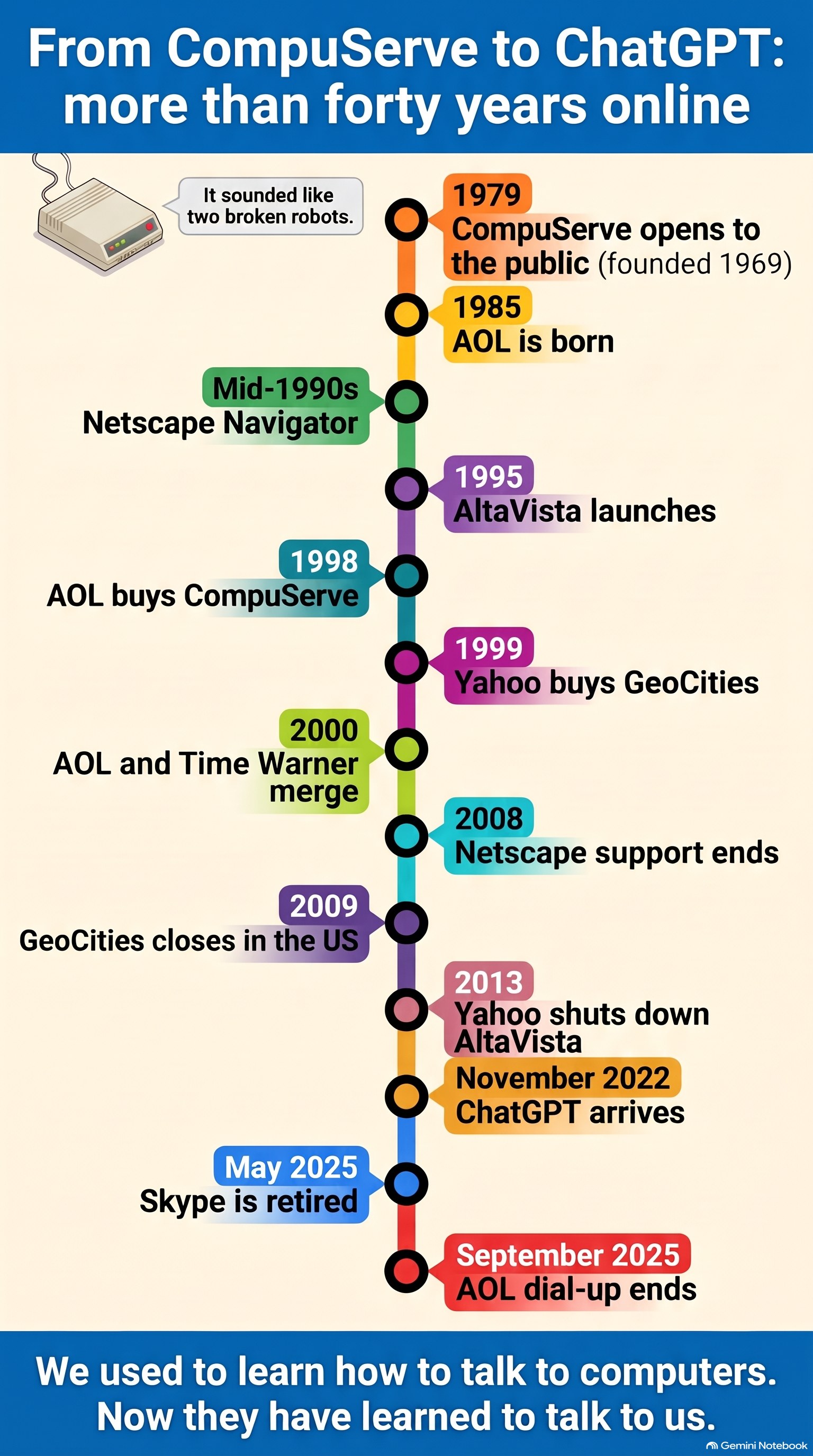
CompuServe was founded in 1969 as a computer services company and began offering online services to consumers in 1979. It did not invent the Internet, but it was one of the great pioneers in bringing electronic communication to the general public.
Its forums brought together people with common interests long before Facebook, Reddit or WhatsApp groups existed.
No algorithms determined to sell you something. No personalised advertising following you around for weeks. And, above all, no one asking you to press a little bell so that you would not miss their next posts.
Connecting did cost money, though. And when the modem began making those sounds that resembled two broken robots mating, you knew you were about to enter another world. Or receive a memorable telephone bill.
 Open full size
America Online: when receiving an email was cause for celebration
America Online, better known as AOL, had existed since 1985 and competed with CompuServe for years.
It offered email, news, chats, content and Internet access. Its famous phrase ‘You’ve Got Mail!’ became a symbol of the era. You’ve got mail!
Today, when we open our inbox and find 87 messages, 72 of which are trying to sell us something, that excitement seems almost touching.
AOL grew into a giant. In 1998 it acquired CompuServe’s consumer service and, in 2000, announced its historic merger with Time Warner.
It seemed that the future of the Internet bore its name. But the future has the unpleasant habit of not consulting major business executives about its plans.
The deal ended up becoming one of the great corporate fiascos in the history of technology. AOL progressively lost its prominence. And in September 2025 it permanently closed its historic dial-up Internet service.
The brand still exists, but that digital empire now belongs to another era.
In technology, being king of the world does not guarantee that you will keep the throne. Or even the modem.
Netscape: the browser that taught us to travel around the world
In the mid-1990s, another unforgettable name appeared: Netscape Navigator.
It was not the first web browser, but it was one of the first to popularise graphical browsing on the Internet. Suddenly, screens began filling with images, links, newspapers, universities and personal pages.
Netscape dominated the market for a time. Until Microsoft decided it wanted its share of the pie too. Internet Explorer eventually displaced it. Support for the Netscape browser ended in 2008, and with it disappeared a name that had been synonymous with the Internet.
The funny thing is that, years later, Internet Explorer was also retired.
The first great lesson from digital history: whoever buries you today may end up buried in the same graveyard tomorrow.
AltaVista: we knew how to search before Google too
Another name I remember with particular affection is AltaVista.
Launched in 1995, it was one of the great search engines of the web’s early years. You entered a few words and pages appeared from places you had not even imagined existed. It was like entering an infinite library without knowing exactly where the books were.
Then Google arrived. Google did not invent Internet searches, but it managed to make them extraordinarily simple and effective. And the world switched search engines.
Yahoo bought it indirectly (via Overture, 2003) and closed it in 2013. Its address began redirecting to Yahoo and the AltaVista name disappeared. A rather cruel irony for a search engine that had helped us find millions of pages.
GeoCities: when we were all architects of the Internet
GeoCities deserves a chapter of its own. I remember it perfectly because I also used it in my professional activity, in the world of travel.
It allowed millions of people to create their own websites without needing to be programmers. Suddenly, anyone could have their own little corner of the Internet.
The design was another matter, of course. Impossibly coloured backgrounds, flashing letters, visitor counters and music that began playing without asking permission.
Some pages looked as though they had been designed by a committee of traffic lights in the middle of a nervous breakdown. But that did not matter.
What mattered was that the Internet was no longer merely a place where we could consult information. Now we could create it too.
GeoCities was acquired by Yahoo in 1999 and its US service closed in 2009.
Today, anyone can build a sophisticated website using visual tools. But those of us who started with GeoCities know how extraordinary it felt to publish our first page back then. Even if it had yellow letters on a violet background.
The graveyard of the technology giants
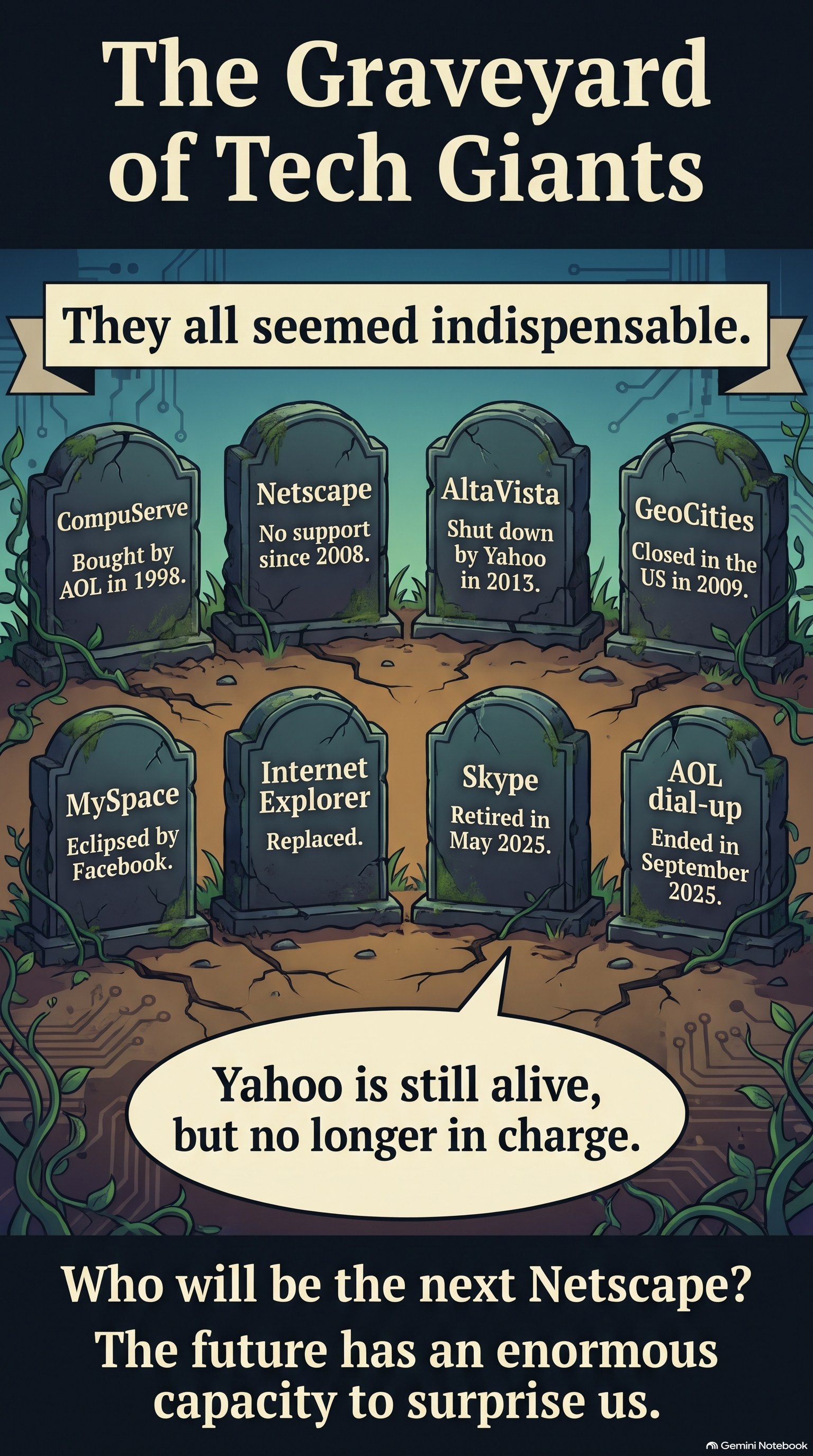
CompuServe, Netscape, AltaVista and GeoCities were not isolated cases.
MySpace became one of the most important social networks before being eclipsed by Facebook. For years, Yahoo was one of the great gateways to the Internet. It still exists, although it no longer occupies the dominant position it once held. Internet Explorer, which had defeated Netscape, was eventually replaced. And Skype, which taught us to make calls over the Internet, was retired in May 2025.
They all had their moment of glory. They all seemed indispensable.
 Open full size
The Internet grew up
With the new millennium and smartphones, we no longer needed to sit in front of a computer to connect. We carried the Internet with us. And since then, it seems that the Internet carries us too.
We used to wait patiently for a modem to establish a connection. Today we become indignant if a page takes four seconds to open.
We have made enormous technological progress. In patience, rather less.
And then ChatGPT arrived: now the computer has opinions too
Just when it seemed that we had witnessed every great revolution, generative artificial intelligence appeared.
It had been under development in universities and laboratories for decades. But the public arrival of ChatGPT, in November 2022, led millions of people to discover that they could converse with a computer system in their own language. Without learning commands. Simply by asking. And the machine replied.
Artificial intelligence also allows us to collaborate with systems capable of processing that information and helping us carry out tasks.
Here lies the connection with CompuServe. Back then, the extraordinary thing was being able to ask people on the other side of the world a question. We shared knowledge. It was an early form of collective intelligence.
Today, we have added a new interlocutor. It is no longer simply a matter of finding someone who knows the answer. We can converse with systems that help us research, compare, write and organise information. And we are beginning to use agents capable of working with applications under our supervision.
Naturally, they make mistakes too. Sometimes they invent answers with a confidence that some politicians could only dream of.
Personally, after so many years of using digital tools, I find this evolution as fascinating as those early days of CompuServe. We used to have to learn how to speak to computers. Now they have learnt how to speak to us. And some of them talk so much that one ends up missing the silence of the modem.
Who will be the next Netscape?
Today we look at major companies that seem invincible. Google, Microsoft, Apple, Amazon, Meta, OpenAI…
But Netscape, AltaVista, AOL and so many others also seemed invincible.
Will the same companies still dominate ten years from now? Will a new technology emerge that turns today’s assistants into museum pieces?
I do not know. And I suspect many executives do not know either. Because if the Internet has taught us anything, it is that the future has an enormous capacity to surprise us.
We are still discovering the same world
One thing has not changed: curiosity. That feeling that behind a screen lies a universe of possibilities that we have yet to discover.
The same feeling I had when I discovered CompuServe. And probably the same one I feel today when I use artificial intelligence.
Perhaps that is the best part of this adventure.
Because if there is one thing I am certain of, it is that twenty years from now someone will write an article looking back nostalgically at ChatGPT. And they will probably say:
‘Do you remember when we had to type questions to artificial intelligence? What primitive times those were!’
In the meantime, I will keep exploring. With the same curiosity I had back then.
I only hope that the next revolutions do not force us to listen to those modems again. Although, come to think of it, they had considerably more personality than many of today’s notifications.
Recableado | November 2026 A personal look, with memory and a little humour, at more than forty years of digital revolution.
What did you think?