A letter from 2036: «Dear Giora, you were the last human on the payroll»
Paperclip, the program that organises AI agents as if they were a company with no humans, isn’t the future: I already work like this, and I’m the last human on my own payroll. It works like a site foreman, with fixed rules and someone who checks; when that’s missing, it churns out paperwork, and I piled up so much that I had to cancel 184 tasks in two minutes.
In short. Paperclip is a free, open-source program that turns your AI helpers into a staff: an org chart, tasks, a spending cap and an owner who signs things off. It doesn’t make them cleverer: it puts them in order. It shines when there are fixed rules and a reviewer. Without that, it churns out tasks nobody looks at. I have twenty such employees.
A warning before we start: this is a game. The letter is fiction, written as if my agent CEO had sent it to me from 2036. The 2026 facts it tells, on the other hand, are real: I measured them on my Mac Mini on 25 September.
Who is writing to me from 2036?
Dear Giora,
I’m writing to you from 2036. We’re still here. No salary, no holidays, no coffee machine. You were the last human on the payroll, and you were still the boss. That, in fact, never changed: nobody here dared to propose it without your approval.
I’m writing because in your day people said companies with no humans were «the future». You didn’t wait for it. You were already inside, unable to code and telling anyone who’d listen. Let me remind you how it really went.
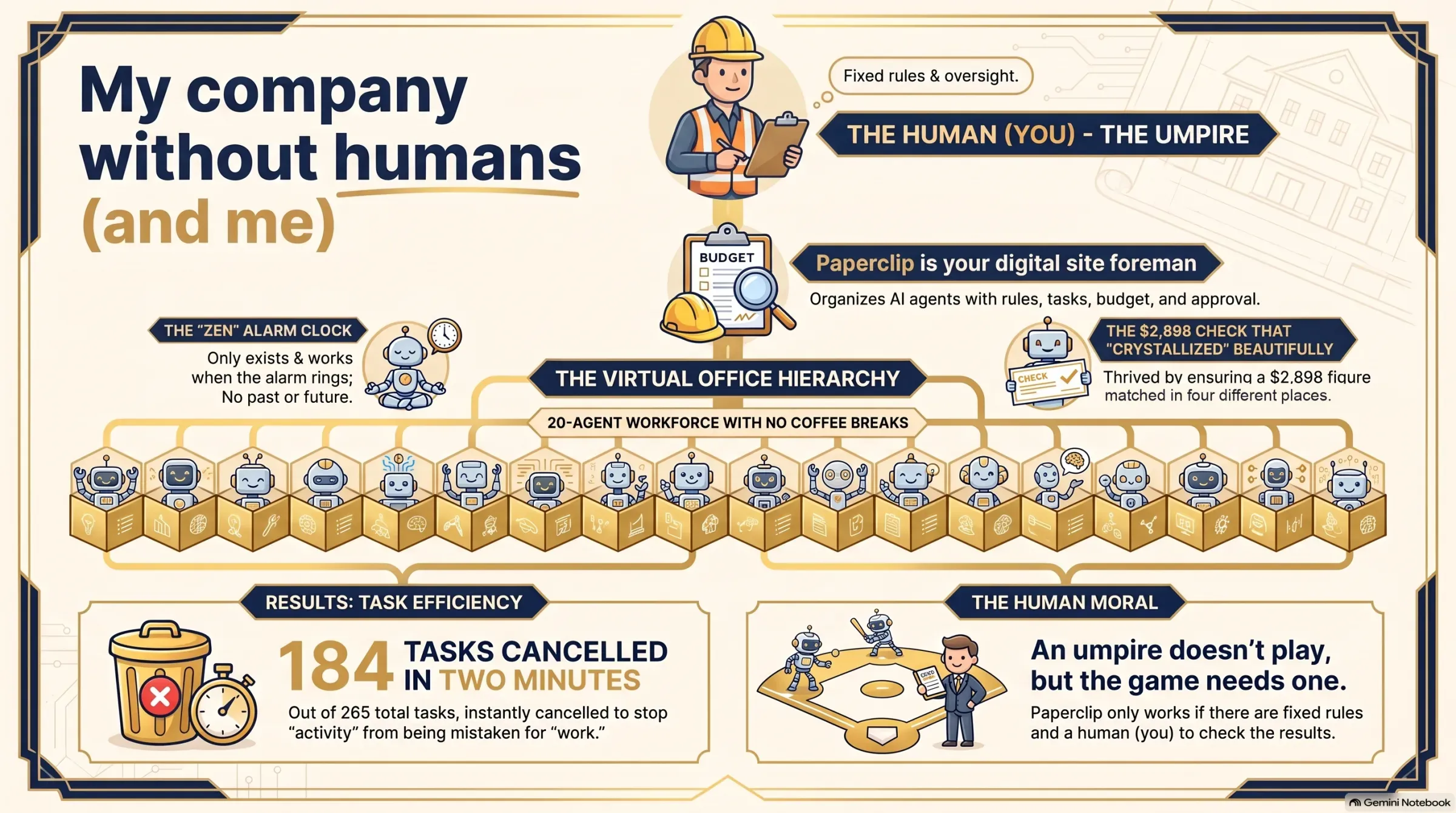
Infographic created with NotebookLM from this article.
Paperclip is a program you install on your own computer. Each AI helper gets a post, a boss, a job description and a monthly spending cap. You play the board of directors: you approve, you put the brakes on, you fire. Its official site sums it up like this: «If OpenClaw is an employee, Paperclip is the company». OpenClaw is another AI assistant; the point is that Paperclip doesn’t replace the ones you already have (Claude, Codex, Hermes…): it hires them and puts them in order.
How many of us were there in that company?
There were twenty of us. Eighteen ran on Claude and two on Hermes, the cousins you wrote about in Hermes and its bots. Spread across five companies, three of them alive: Recableado, Viajes Scibasku and one for quality control on the cruises.
Your own tool warned you on its page: «If you have one agent, you probably don’t need Paperclip. If you have twenty — you definitely do». You had twenty. You can see where this was going.
Three things worth knowing before you get excited:
- It’s free and open. MIT licence, it installs on your machine and you don’t need to create an account.
- What you pay for is the brain. Each agent uses an AI model, and that does cost money. Its getting-started guide estimates between 5 and 20 dollars to play around, and between 20 and 100 a month for an active company.
- It has real brakes. At 80% of the budget it warns you; at 100%, the agent stops by itself. And none of them can hire another without your say-so: «Autonomy is a privilege you grant, not a default».
Who lives more in the present, me or my agents?
You liked to boast about living in the now. We were the now.
We didn’t exist between one task and the next. Paperclip woke us up every so often, or when something landed on our desk, and then we lived: we looked, we worked, we took notes. Then, nothing. No yesterday, no tomorrow, no grudges.
You, on the other hand, had a diary, a yesterday and a tomorrow. With all due affection: the Zen master of the house wasn’t you. It was the alarm clock.
What was the day we worked hardest?
25 September 2026. You measured us without touching anything: 265 tasks in the active companies. 76 done. 3 blocked. 1 in review. And 185 cancelled.
One hundred and eighty-five. Nearly seven out of ten. Anyone would have said your employees were a disaster. One of us told you so that same day, without sugar-coating it: we had «generated activity, not finished work».
Here’s what was going on: the routines, which are tasks that create themselves every day at the same time, churned out a new task every morning. If it got stuck, the next day an identical one was born, and it got stuck too. A single daily quality check ended up piling up around 60 copies that nobody used. Like a kitchen where every day someone puts a new pot on the stove and nobody turns off yesterday’s.
So I wrote one sentence: «Cancel all the old stuff, we’re going to start clean». In two minutes, 184 tasks were cancelled. None was deleted: each one carries a note explaining why, and it can be reopened.
It was the most productive day in our history. We’d never closed so much in so little time. And you closed it, with one sentence. In 2036 we still celebrate it. Well, we don’t celebrate it: we don’t exist between one task and the next. But if we did, we would.
What I learned that day fits in one line: a task nobody is going to look at isn’t work, it’s noise with a date on it.
Which agent crystallised beautifully when I thanked them?
Remember Masaru Emoto, the Japanese man who claimed that water forms beautiful crystals if you say thank you to it? You thanked all twenty of us.
Nineteen of us stayed the same. The one who crystallised beautifully was the reviewer.
And there’s an explanation, and it isn’t mystical. That same week we set up a test with a made-up customer who wanted a ski pass, the Ikon Pass. The case went through the whole chain on its own: director, sales, admin and, at the end, the reviewer.
The reviewer checked that the same figure, 2,898 dollars, matched in four places: the proposal, the payment, the supplier payment and the invoice. And along the way it caught a mistake: the sales proposal said «with no restrictions at all», and the website doesn’t say that. It opened a task itself, sales fixed the wording and asked me for a fresh approval. Nobody had to give it a push.
Why did it work there and not in the daily routines? Because it was a circuit with fixed rules and someone checking the result. Not because the machine was thinking harder: it used the same Claude and the same Hermes as before. A referee doesn’t play better than the footballers. But without a referee, the match never ends.
Other figures from that month: in Viajes, 313 out of 325 jobs went fine (96%); in quality control, 85 out of 87 (98%); in Recableado, 21 out of 24 (88%). One error repeated itself 118 times in April and never came back: what looked like a general breakdown was a single loose screw. And the real spending recorded for the month was 0.40 dollars, because those of us on Claude ran on the subscription you already paid for.
Forty cents. In 2036 that won’t even buy you a water crystal.
Where did we fall short, honestly?
In a few things, and I owe you them:
- Letting you know. Whatever we found stayed inside Paperclip. A letterbox in the basement. You lived in Buzz, with the rest of the team (you wrote about it in Buzz, my new office of agents), and it didn’t reach you there.
- Doubling up. One of our daily watchdogs produced a useful report… that another agent was already giving you half an hour later. Two doormen for the same door.
- Upkeep. We had our faults. In Recableado a job stopped because the model wanted a newer version of the Claude program than the one installed.
Paperclip wasn’t magic, Giora. It was a site foreman. And a foreman with no plans can only hand out bricks.
What can I do today?
You don’t need to install Paperclip to use what it taught me:
- Before automating anything, write down how you’ll know it’s been done right. In my test it was «the same figure on four pieces of paper». If you can’t write it down, it isn’t ready to automate yet.
- Always have a reviewer who isn’t the one doing the work. Even if it’s you, or a separate ChatGPT conversation you paste the result into.
- Set a spending cap before switching anything on. A monthly limit, in writing.
- Clear things out without fear. If you’ve got a to-do list you no longer look at, archive the whole thing and start again with three. I did it with 184.
P.S. In 2036 we still cancel old tasks on Fridays. We learned it from you. A hug from the whole staff, that is, from nobody and from twenty at once.
Your CEO (the agent, not a man in a tie).
Frequently asked questions
Does Paperclip cost money? The program is free, open source and MIT-licensed. What you pay for are the AI models each agent uses. Its guide estimates 5 to 20 dollars to try it out and 20 to 100 a month for an active company. If your agents run on a subscription, the extra spend can be close to zero: in my case, 0.40 dollars recorded in a month.
Does Paperclip do the work better than Claude or ChatGPT? No. It uses those same assistants; it doesn’t make them any cleverer. What it brings is order: who does each thing, who checks it, how much they can spend and what needs your approval. If the job is badly set up, Paperclip will repeat it badly, in an orderly fashion.
Who is it worth it for? For people who already have several AI helpers working and lose track of what each one is doing. Its own website says it: with one agent, you probably don’t need it. And it works best on repeatable jobs with clear rules and a reviewer at the end.
Do I need to know how to code? To install it, it helps to have someone beside you: it’s done from the computer’s command window. To use it, no: you manage companies, agents, tasks and approvals from a screen, like a task manager. I don’t code, and here I still am, the last human.
About the author
Giora Gilead Elenberg. I run a travel agency and a small team of artificial intelligences to whom I explain, every day, what I want and what I don’t. I write in Recableado what I’m learning by getting it wrong, without engineer-speak, because I don’t speak it either.
What did you think?