Can I be more ambitious with artificial intelligence?
For months, I had some of the world’s most powerful artificial intelligences working for me.
And I used them to move buttons around.
I also used them to summarise emails, tidy tables and correct sentences I had written myself five minutes earlier. It was like buying a nuclear reactor and using it to heat my coffee.
The coffee came out beautifully. That wasn’t the problem.
The problem was that, while I admired how quickly it heated the cup, artificial intelligence was changing shape before my eyes.
First we asked it questions. Then it began reading our documents. After that came the ability to search, compare, program, open tools, check results and work for longer without us having to direct every move.
We are no longer talking only about a chat that writes well. We are beginning to live alongside agents capable of pursuing an objective.
And if the tool has changed so much, perhaps the question we ask it needs to change too.
Can I be more ambitious?
That is the question I want to share today.
Not because I have found a magic formula. Nor because I believe artificial intelligence will solve everything. Quite the opposite: the more capable it becomes, the more important it seems to me to understand what it does well, where it fails and which decisions we must not hand over to it.
For some time, I have been trying to describe the evolution of AI on this blog as I experience it: what I test, what works, what breaks and what I learn when six machines look at the same website and cannot even agree on how many links it has.
My aim is not to turn you into model experts. It is something far more practical: to stop anyone arriving late to a transformation because they think AI is still that chatbot we asked for a recipe or a birthday greeting.
To explore the question, I brought thirteen sources together in a NotebookLM notebook about ambition and artificial intelligence. The piece that organised many of the ideas was an article by Felix Rieseberg: How to be more ambitious: A tutorial for humans with models.
I expected another prompting manual. A template, four magic words and perhaps an acronym I could forget the next day.
Instead, I found a much more uncomfortable question:
What do you actually want to happen after this task is finished?
Not “what document do you want?” Not “which button needs moving?” What do you want to happen?
I looked at the jobs I was giving the machines and had to admit it: I was thinking too small.
When asking well is no longer enough
Until now, we have spent a lot of time learning how to ask. How to write precise instructions, add context and explain the format of the answer.
All of that is still useful, but it falls short when AI can do more than answer.
If a machine can research, cross-check documents, use tools and verify part of its own work, the instruction “make me a PDF” wastes almost all of that capacity.
The PDF is an object. The outcome is that someone understands something, makes a decision or manages to do what they could not do before.
At my agency, for example, I could ask:
Make me a PDF for this trip.
Or I could raise the objective:
Help this customer decide whether this trip is right for them. Explain why each option was chosen, prove every fact, keep the uncertainties visible and do not send anything until I approve it.
The machine may end up creating a PDF in both cases. In the second, however, it is no longer working to manufacture pages. It is working to produce understanding.
“Write an email” can become “get a useful reply without damaging the relationship with the supplier”.
“Fix this website” can become “help the visitor understand what we offer and act without getting lost”.
“Find three hotels” can become “build a selection I can defend in front of this particular customer”.
The difference is not a longer instruction. It is daring to commission a more important outcome.
Altitude: looking up from the nuts and bolts
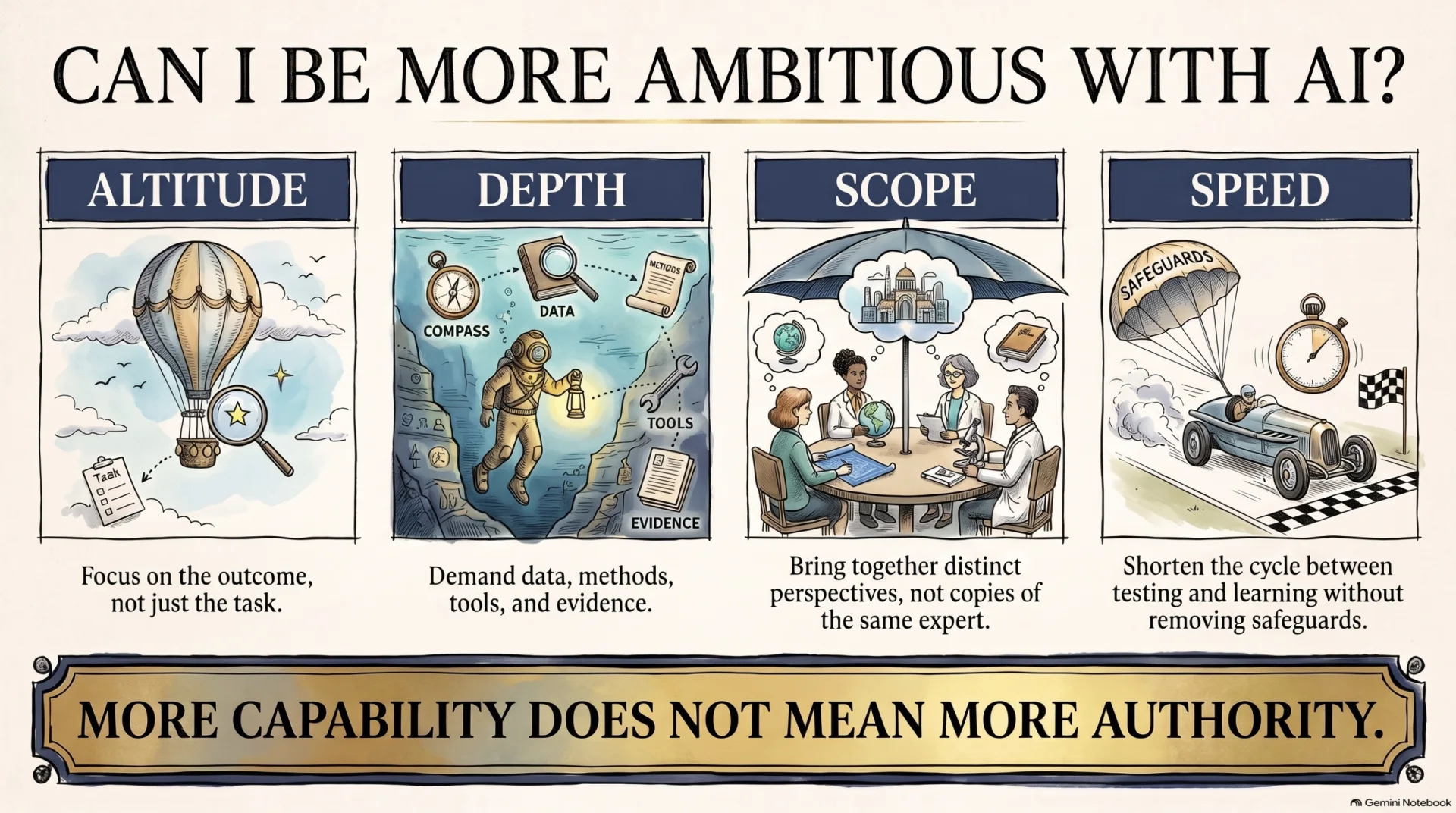
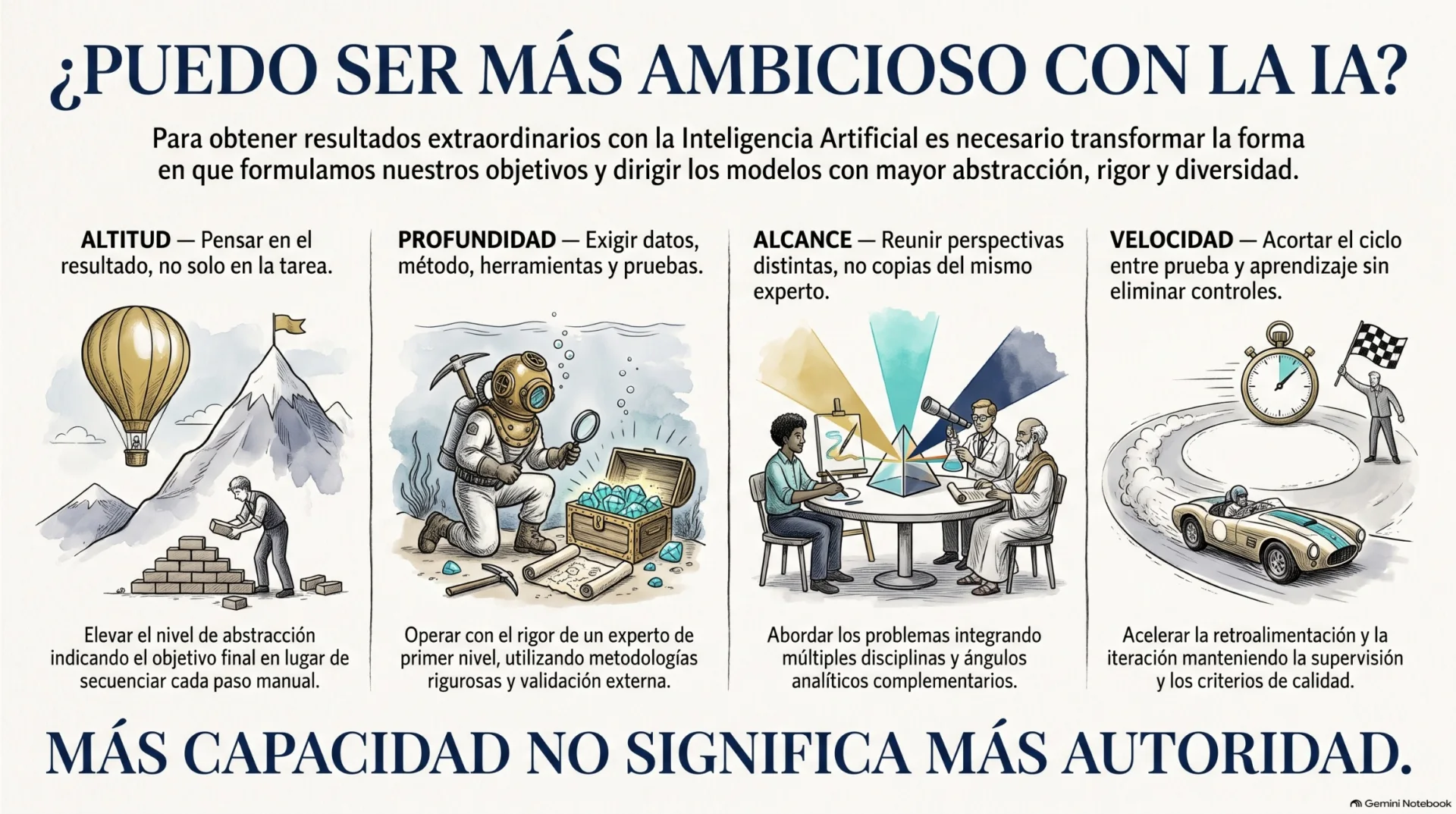
The framework I studied calls this change altitude.
At ground level we see tasks: a text, a table, an image, a button. When we climb higher, we see what they are for.
That changes the conversation with artificial intelligence, but it also changes our own way of thinking. We are often the ones who have turned work into a collection of parts, because asking for something small and easy to control feels more comfortable.
The altitude question is:
What do I want to be different when this is finished?
You do not always need to climb. If the button is misaligned, fix the button and everyone is happy. But it is worth checking that we are not using an extraordinary tool to perfect a task that is no longer the right one.
Depth: taking off the imaginary tie
For years, we wrote “act as the best expert in the world”.
The machine put on an imaginary tie, added three technical terms and returned the same superficial answer dressed up as a lecture.
Depth does not mean asking for jargon. It means demanding a method.
What data would a competent professional need? Which tools would they use? What would they try to disprove? What external test would show that the work is sound? Which part cannot be verified with the available information?
I have already told the story on this blog of asking six agents to review the same website. They agreed on the serious problems, but they could not even agree on the number of links. Each had looked with a different method, and almost none told me which one it had used.
That experience taught me that a confident answer is not a proven answer.
AI has made huge progress in its ability to do. Now we need to make progress in our ability to check.
Scope: do not hire five copies of the same expert
The third dimension is scope.
One of the most interesting possibilities of agents is bringing together perspectives that would not normally sit at the same table. Not asking five machines to do the same thing under different names, but giving each one a role and a method.
For a travel proposal, for example, I might bring in someone who knows the destination, a person obsessed with clarity, a family travelling for the first time, a couple looking for something special and a professional Booking.com comparison shopper.
It is the heist film, except instead of robbing a bank we are trying to stop a quotation looking as though it was written by one.
That led to an experiment I want to try in my business: the Customer Council.
Four simulated customers read a proposal before it leaves the building. The experienced traveller looks for superficiality. The family asks what will happen each day and what happens if something goes wrong. The luxury couple looks for signs of something genuinely special. And the Booking.com shopper asks why they should book with me.
None of them decides. None of them books. None of them speaks to the real customer.
Their job is to find the objections before they reach the other side of the table. Mine is to decide which ones are valid.
Speed: learning sooner, not removing the brakes
The fourth dimension is speed.
This is where artificial intelligence gets carried away easily. I asked the notebook to apply these ideas to a travel agency, and it proposed analysing medical forms for diving, rescheduling trips automatically and promising response times unsupported by any data.
Very ambitious. Also an excellent way to ruin a travel agency before breakfast.
Moving faster does not mean skipping controls. It means shortening the time between an idea, a test, a mistake and the next attempt.
Preparing one variation used to cost so much that we made only one. Now we can compare several, expose them to different criticism and learn before sending anything.
Speed is for testing sooner, not for publishing before thinking.
The boundary I do not want to erase
This is the most important part of the article.
Being more ambitious with AI does not mean giving it more authority.
It means asking for a bigger outcome, providing better sources, demanding deeper evidence and using more perspectives. But the decision remains human whenever a mistake costs money, safety or trust.
An artificial intelligence can compare a hundred pages without tiring. It can flag contradictions, test a website, prepare scenarios and find a sentence that promises more than we can prove.
But it has not accompanied a family on their first ski trip. It has not seen a diver’s face when the sea changes. It does not know whether a silence on the phone means fear, excitement or that the customer has just looked at the price and is trying to breathe normally.
That is not romanticism. It is work.
My role does not shrink as the machine becomes more capable. It moves. I stop pushing every pixel and sentence and concentrate on deciding what deserves to exist, which risks I accept and what I can truly promise another person.
The questions I ask myself now
This evolution forces me to revisit jobs that once seemed normal:
- Am I asking for a piece, or for the outcome that piece should achieve?
- Have I given the AI the right data and tools, or am I asking it to improvise?
- How will I prove that what it delivers works outside its own answer?
- Which other perspectives might uncover something I cannot see?
- Which decision must remain exclusively human?
And above all:
Can I be more ambitious without becoming more reckless?
I think I can.
In fact, that may be the great opportunity of this moment: using the enormous new capacity of models without confusing capacity with judgement.
Why I want to tell this story
Recableado was born, in part, to share what is happening to me with artificial intelligence while it is still happening.
I do not want to write from a podium, explaining the future after it has already happened. I would rather open the workshop: show the experiment, the mistake, the tool that did not exist yesterday, the agent that did something surprising and the occasion when I had to stop it because it was inventing the bridge as it crossed it.
The advances arrive so quickly that it is easy to keep an old photograph in your head. Someone who tried an AI a year ago and got a mediocre answer may think nothing has changed. Someone who sees only spectacular demonstrations may believe the opposite: that nothing needs checking any more.
Both pictures are false.
Today’s AI can do far more than most people ask of it. And it can still be spectacularly confident while being wrong.
That is why I want to keep telling the story here. Not so that we all adopt every new tool, but so that we can decide with knowledge. So that a small business, a professional or a curious person can look at these capabilities without fear, but without kneeling before them either.
My goal is not to convince you that AI can do everything.
It is to help you ask a better question:
Given what artificial intelligence can already do today, which important problem am I still treating as a collection of small tasks?
I have already found a few.
 Open full size
View the infographic in Spanish
 Open full size
The reactor and the coffee
I will carry on using artificial intelligence to correct texts, organise tables and move buttons. There is no need to ban coffee just because we own a reactor.
But I no longer want to spend all day admiring how quickly it heats the cup.
I want to learn what else the machine can do. I want to share its new abilities without hiding its failures. I want to test them on real problems. And I want to keep the last word when the decision matters.
Perhaps being more ambitious does not mean asking AI to replace us.
Perhaps it means stopping asking it for small things and beginning, together, to ask bigger questions.
Five quick answers
What does being more ambitious with artificial intelligence mean?
It means asking AI for the outcome you want to achieve, not merely for an isolated piece. It also means giving it better sources and tools, demanding methods and evidence, bringing in different perspectives and keeping human control over decisions with real consequences.
Does being more ambitious with AI mean giving it more autonomy?
Not necessarily. Ambition can increase the size and depth of the assignment without increasing the machine’s authority. Decisions affecting money, safety, publication, bookings or trust must retain explicit human approval.
What are the four dimensions of ambition with AI?
Altitude means thinking about the outcome rather than only the task; depth means demanding data, tools, method and evidence; scope means bringing together different disciplines and perspectives; speed means shortening the cycle between testing and learning without removing controls.
How has artificial intelligence evolved beyond the chatbot?
Besides writing answers, today’s systems can work with documents, research, compare information, use tools, program and carry out multi-step tasks. That greater capacity requires us to verify methods and results instead of trusting the confidence of the answer.
What role does the person retain when working with AI agents?
The person decides what deserves to be done, provides the context missing from the data, chooses which risks to accept, checks the evidence and approves actions with consequences. AI expands the capacity for work, but it does not replace judgement or responsibility.
Main sources: the NotebookLM notebook «El arte de la ambición con inteligencia artificial» (“The art of ambition with artificial intelligence”, 13 sources) and the Felix Rieseberg article linked in the text. The applications to Viajes Scibasku are interpretation and proposals, not measured results.
What did you think?