Claude Without the Bleeding: How We Closed a 24/7 Token Leak
Some crises do not begin with an explosion.
They begin with a counter falling too fast.
The Claude Quota Crisis was not an epic disaster. It was something more dangerous: a quiet, ordinary, perfectly technical leak. The kind of problem that does not feel urgent until you realize your AI system has been breathing through invisible holes for hours, maybe days.
The symptom was simple: quota was disappearing.
The cause was not.
It was a system with too many open doors.
The Leak
First came the vampire process.
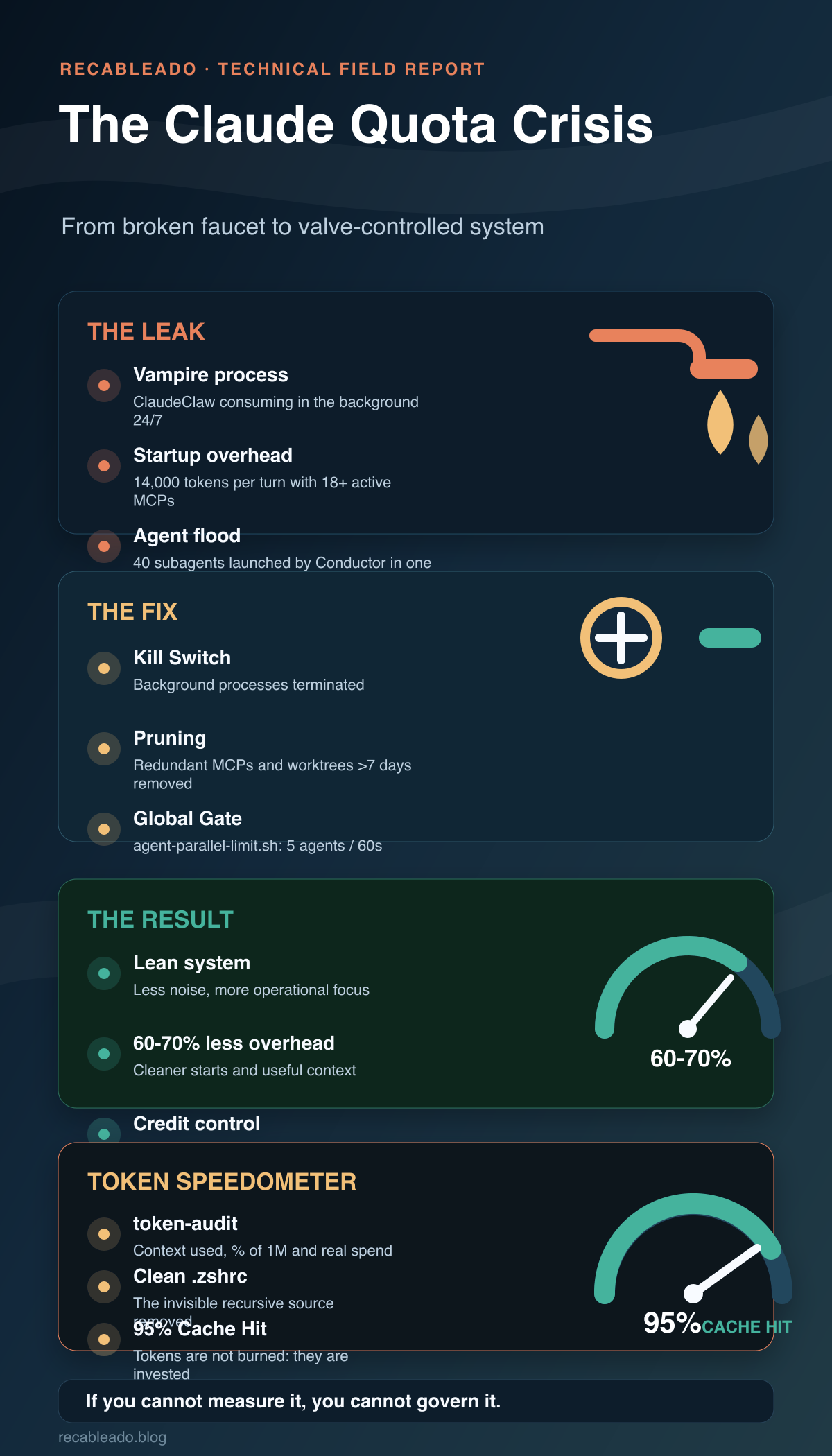
ClaudeClaw was still alive on the Mac Mini, consuming in the background as if it had a permanent chair inside the machine. It was not producing visible work. It was not creating value. It was simply there, attached to the neck of the quota, 24/7.
Then we found the second hole: startup overhead.
Every Claude turn was born with an absurd backpack: around 14,000 tokens of overhead before the real thinking even started. The reason was obvious once we looked: too many active MCPs, more than 18 tools breathing at the same time, all entering the room even when most of them were irrelevant to the job.
And then came the third front.
The Conductor launched 40 subagents in a single day.
That was no longer automation.
That was a flood.
The AI was not lazy. It was too obedient inside an architecture without enough valves.
The Intervention
The solution was not asking Claude to “spend less.”
That would have been like asking a broken pipe to be polite.
The solution was to redesign the system.
1. Kill Switch
First, we closed the visible leak.
Background processes that kept consuming without doing real work were killed. Not gently suspended. Killed.
In an operational AI system, a zombie process is not a nuisance. It is a ghost subscription.
2. Pruning
Then came the least glamorous and most important part: cleaning.
Redundant MCPs out. Worktrees older than seven days out. Configurations that had accumulated through enthusiasm, experiments and urgency, out of the default startup path.
Pruning does not reduce capability.
It reduces noise.
And in AI, noise is paid twice: first in tokens, then in judgement.
3. The Global Gate
The final piece was a valve.
agent-parallel-limit.sh: maximum 5 agents every 60 seconds.
Not to prevent the system from working. To prevent it from overflowing. There is a large difference between granting autonomy and letting an architecture launch subagents as if the credit counter were decorative.
AI can still run.
But now it runs on a track.
The Result
The system became lean.
Lighter. More governable. More serious.
Startup overhead dropped by 60 to 70%. Every turn began cleaner. Context became a tool again, not ballast. And most importantly: credit spend stopped feeling like weather.
Now it is a panel.
Switches. Valves. Limits. Traceability.
That is the Recableado philosophy: do not shut the machine down out of fear. Teach it to breathe with discipline.
Because the real problem was never Claude.
The problem was confusing power with absolute freedom.
Final Act: The Speedometer
The real victory was not turning things off.
It was measuring.
After killing background processes, pruning MCPs and cleaning old worktrees, we built the missing instrument: token-audit.
We did not want guesses. We wanted data.
Now we have a command that tells us how much context we are using, what percentage that represents of the 1 million token window, what the cache hit is, and what the real spend looks like. It is the system’s speedometer. The panel that turns anxiety into telemetry.
The workshop law is now written:
If you cannot measure it, you cannot govern it.
Then came the invisible error.
The system was not only heavy because of too many tools. There was a bug hidden in .zshrc: a recursive source. A configuration calling itself like a staircase with no final step.
The metaphor was too perfect to ignore. Sometimes a machine is not slow because it lacks power. It is slow because it is trapped inside an infinite loop of its own configuration.
That discovery closed the circle: killing the vampire process was not enough. We had to clean the electrical house from the inside.
The number that changed the mood was this:
95% Cache Hit.
That means that after pruning and cleanup, the AI stopped throwing tokens on the floor. It started reusing context intelligently. We were no longer burning credits to repeat ourselves. We were investing them to move forward.
For a 72-year-old Vibe Coder, there could not be a better ending: we survived a quota crisis and came out with infrastructure more professional, more measurable and more governable than what many younger developers would love to have.
This was not a retreat.
It was a command upgrade.
Copyable Technical Summary
#!/usr/bin/env bash
# Recableado Claude Quota Crisis - technical summary
# Goal: stop background leaks, reduce startup overhead, limit agent floods,
# and measure the system instead of guessing.

set -euo pipefail

### 1. Kill Switch: stop vampire background processes

echo "[kill-switch] Looking for ClaudeClaw background processes..."

pkill -f "ClaudeClaw" 2>/dev/null || true
pkill -f "claude.*background" 2>/dev/null || true

echo "[kill-switch] Background leak sweep complete."


### 2. Pruning: reduce default context load

echo "[prune] Manual MCP audit:"
echo "  - Disable redundant MCPs"
echo "  - Keep only high-value tools in the default startup path"
echo "  - Avoid loading 18+ tools when the task does not need them"

echo "[prune] Worktrees older than 7 days:"
find . -maxdepth 3 -type d -name ".git" -mtime +7 \
  | sed 's#/.git##' \
  | sort

# Optional deletion pattern, only after review:
# find ./worktrees -maxdepth 1 -type d -mtime +7 -print -exec rm -rf {} \;


### 3. Global Gate: limit agent launches

# Save as: agent-parallel-limit.sh
# Policy: max 5 launches per 60 seconds.

cat > agent-parallel-limit.sh <<'EOF'
#!/usr/bin/env bash
set -euo pipefail

LIMIT=5
WINDOW_SECONDS=60
STATE_DIR="${TMPDIR:-/tmp}/recableado-agent-gate"
STATE_FILE="$STATE_DIR/launches.log"
LOCK_FILE="$STATE_DIR/gate.lock"

mkdir -p "$STATE_DIR"

now="$(date +%s)"

(
  flock -x 200
  touch "$STATE_FILE"

  awk -v now="$now" -v window="$WINDOW_SECONDS" \
    '$1 >= now - window { print $0 }' "$STATE_FILE" > "$STATE_FILE.tmp"

  mv "$STATE_FILE.tmp" "$STATE_FILE"

  count="$(wc -l < "$STATE_FILE" | tr -d ' ')"

  if [ "$count" -ge "$LIMIT" ]; then
    echo "[agent-gate] Blocked: $count launches in the last ${WINDOW_SECONDS}s."
    echo "[agent-gate] Limit is ${LIMIT}/${WINDOW_SECONDS}s. Try again shortly."
    exit 42
  fi

  echo "$now ${*:-agent}" >> "$STATE_FILE"
  echo "[agent-gate] Allowed: $((count + 1))/${LIMIT} in current window."

) 200>"$LOCK_FILE"

# Put the real agent command here, for example:
# exec claude-agent "$@"
EOF

chmod +x agent-parallel-limit.sh


### 4. Token Speedometer: measure before governing

# Command contract for token-audit:
#   - context used as % of the 1M token window
#   - cache hit rate
#   - real credit/token spend signal
#
# Example output target:
#   context_window_used: 8.7% / 1M
#   cache_hit: 95%
#   startup_overhead: down 60-70%

token-audit

echo "[done] Lean mode enabled: fewer leaks, lower startup overhead, controlled fan-out, measured spend."
Closing
A serious AI system is not measured only by what it can do when everything goes well.
It is measured by what it stops doing when nobody is watching.
Today Claude is useful again because the architecture has governance, a speedometer, and clean memory.
And that, in the end, is the difference between using AI and truly rewiring yourself: not leaving the crisis more cautious, but leaving it with better instruments.
What did you think?