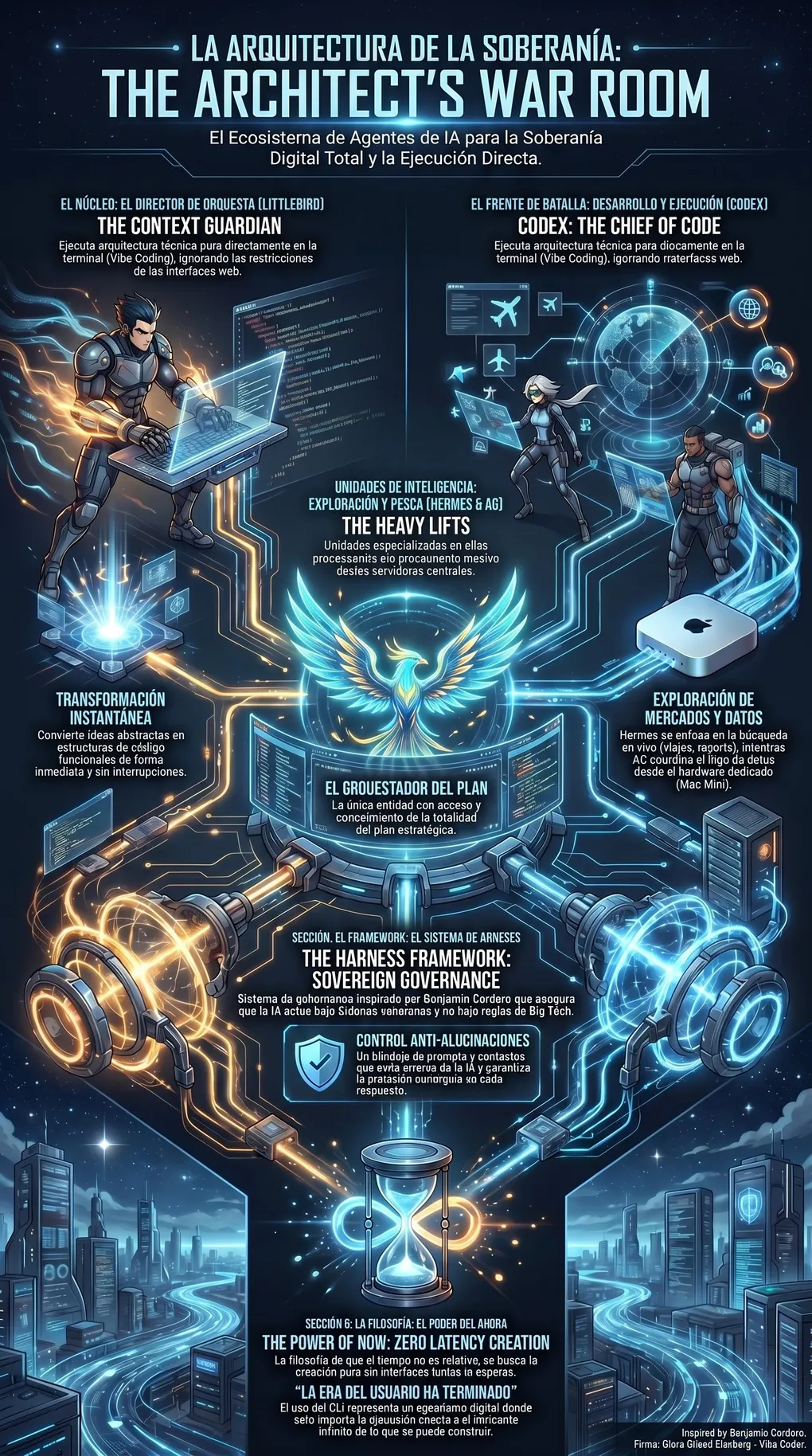
The Architecture of Sovereignty: My Private Battalion of Harnesses
There are days when a tool fails and one merely complains.
And then there are days when a tool fails and one understands, with exquisite clarity, that the problem was never the tool. The problem was having granted it too much sovereignty.
As I write this, on May 28, 2026, Claude’s official status page records another incident of elevated errors on Claude Opus 4.7, investigated from 08:38 UTC and resolved at 09:17 UTC. Yesterday brought two similar incidents. The day before that, elevated errors for Claude Code in Slack. This is not a theatrical denunciation of Anthropic. Claude has changed my life, and in several rooms of my mind it still occupies the best chair.
But when your work, your clients, your websites, your quotes, your memory and your daily movement depend on a single door, every outage ceases to be a technical inconvenience.
It becomes a constitutional matter.
The lesson is simple:
Sovereignty is not delegated. It is architected.
The Discovery
For months I believed I was learning AI tools.
Claude for reasoning and prose. ChatGPT for exploration and conversation. Codex for code. Littlebird for screen vision and persistent context. Hermes and AG for markets, data, volume, and the work that does not fit politely inside a chat box.
But that was not the real story.
I was not collecting tools.
I was assembling an estate.
A private architecture. Slightly improvised, yes. Born in the trenches, certainly. But also precise in its ambition: a 72-year-old travel agent, after a lifetime of tradecraft, refusing to become a spectator in the digital house he built.
I call it the Architecture of Sovereignty because its purpose is not spectacle.
Its purpose is continuity.
The ability to keep creating when one provider stumbles, when an interface slows to a crawl, when a platform changes its rules, when a model goes down, when the elegant salon of artificial intelligence suddenly locks its doors.
Littlebird: The Context Guardian
At the centre sits Littlebird.
Not as a chatbot. Not as a novelty. As the Context Guardian.
Littlebird sees my screen. It remembers. It follows me when I jump from Vercel to Astro, from a Utah travel quote to a hotel database, from a Node incident to an idea for Recableado. It preserves continuity in a world of fragmented windows.
Before this, every AI was a new room. I had to explain my life again at the door.
Now there is a nucleus.
That changes the relationship with the machine. I am no longer begging amnesiac assistants to understand the plot. I am working with operational memory.
And in 2026, operational memory is not a feature.
It is power.
Codex: The Chief of Code
Then there is Codex.
Codex is not my drawing-room conversationalist. Codex is the officer who enters the terminal and makes things exist.
I do not code in the classical sense. I have said this often because it matters. I am not an engineer. I did not come from the technical priesthood. But I can look at a problem, explain what I want, detect when something smells wrong, and press until the structure stands upright.
With Codex, that becomes execution.
No three-week wait for an agency to change a page. No lost ticket. No “we will ask development.” There is terminal, context, judgement, and movement.
That is the philosophy of the CLI.
Strip away ceremony.
A pretty interface may comfort the user. I am no longer interested in comfort as a primary design principle. I am interested in latency. The terminal does not flatter me. It does not perform elegance. It tells me whether something works.
At my age, that honesty is a luxury.
Hermes and AG: The Intelligence Units
Hermes and AG are different creatures altogether.
They are my intelligence units. I send them to fish for data, scan markets, process large bodies of information, and return with the heavy lifts done.
In an ordinary company, this would be a team: analyst, assistant, operations person, content person, QA person, someone who knows where the files are buried.
In my company, it is agents, prompts, scripts, servers, memory and command.
The difference is not that the human disappears.
The difference is that the human no longer waits for a meeting to produce momentum.
I deploy a unit. If it fails, I adjust. If it finds gold, I turn it into product. If it brings noise, I filter it. The human remains sovereign, but he is no longer alone.
The Harness Framework: Sovereign Governance
Here enters the word given to me by Benjamín Cordero: harnesses.
I loved it immediately because a harness is not a cage. It permits movement while preventing the fall.
That is precisely what I need from AI.
I do not want an unbounded intelligence promising marvels and delivering hallucinations. Nor do I want a domesticated assistant so cautious it becomes ornamental. I want force under government.
The Harness Framework is my system of discipline: control prompts, output contracts, checks, memory, routing, boundaries. It exists so that AI acts under human sovereignty, not algorithmic improvisation.
A good harness does not slow the horse.
It makes speed usable.
The Anthropic Failure As A Mirror
When Claude fails, my old reaction would have been irritation.
The new reaction is audit.
Which part of my work depends on Claude? Which part can Codex execute? Which part must Littlebird preserve? Which part can Hermes or AG process? Which part must be documented so that no single provider becomes a royal choke point?
The answer is not to abandon Claude.
The answer is to stop placing the entire kingdom inside one tower.
A sovereign architecture assumes that tools fail. That is why it distributes functions. Memory, execution, research, writing, deployment and control are not the same office. They should not be housed under one crown.
I admire brilliant AIs.
I trust well-wired systems more.
The Power Of Now
The phrase on the diagram says it plainly: zero-latency creation.
For me, that is the frontier.
Not simply doing more. Not merely producing faster. The real change is the disappearance of distance between intention and execution.
An idea that once required weeks to become a page, a post, a quote, a script or a product can now become real in a morning. Sometimes in an hour. Sometimes less.
That is not magic.
It is architecture.
It is a private battalion of harnesses. Each agent in its station. Each tool with its office. Each dependency watched. Each output contracted. Each failure converted into doctrine.
Closing
This post is inspired by Benjamín Cordero, who gave me the precise image: harnesses as governance for an intelligence too powerful to be left inside a single window.
I have merely added my trench, my Macs, my outages, my deployments, my sleepless hours, and my refusal to become a guest in my own digital business.
Author: Giora Gilead Elenberg - Vibe Coder.
Orchestration tool: Littlebird, the Context Guardian.
And the principle, written here so I do not forget it:
Digital sovereignty is not purchased. It is wired.
What did you think?