
Stop Collecting AI Tools. Start Solving Problems.
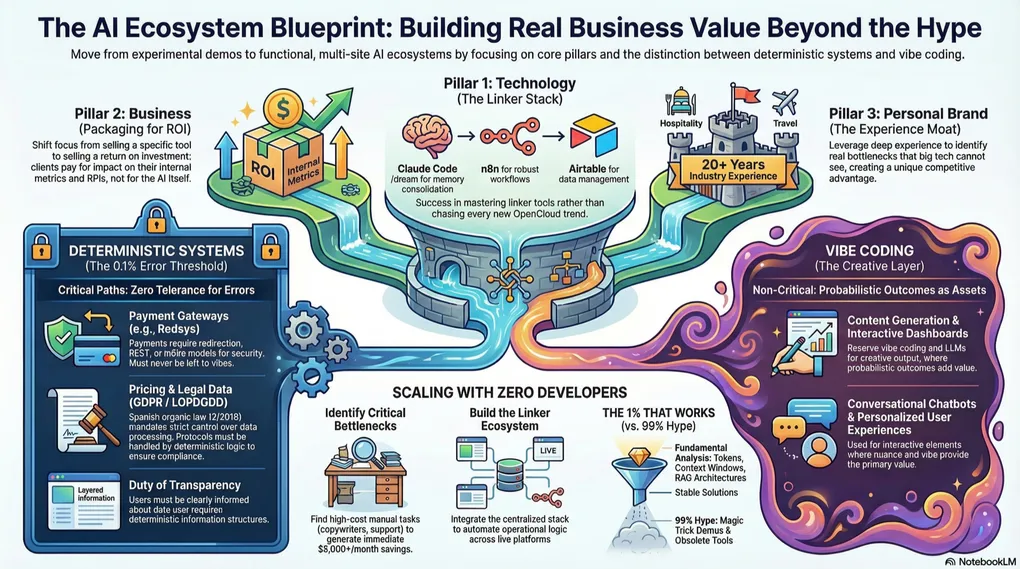
A few days ago I watched a video by Agustín Medina that made me feel deeply understood. His thesis is simple: 99% of what comes out every week in artificial intelligence is noise. And the 1% that actually works can transform a business — if you know where to put it.
I’ve been running Viajes Scibasku for 20 years. I sell scuba diving trips, liveaboards, premium ski holidays. I’m not a programmer. I’m not a “tech founder.” I’m a 73-year-old guy who organizes dive trips to the Red Sea and ski getaways to Niseko. And yet, this year I’ve built a tech ecosystem that many startups would envy.
The difference is that I don’t collect tools. I use them.
The weathervane and the anchor
Medina uses a metaphor I love: he says we’ve become weathervanes, spinning every time a big tech company launches something new. OpenCloud, Antigravity, the latest trendy plugin. We consume, consume, and never move forward.
I went through that phase too. I tried Make, custom GPTs, ten different AI website builders. Wasted weeks. Until one day I stopped and asked myself: what does my business actually need?
The answer wasn’t spectacular: I needed that when a client messaged me asking about a liveaboard in the Maldives, I could reply within minutes with a personalized quote — beautiful, with real photos from my suppliers, and a chatbot that actually knew which boat we were talking about. That’s it. Not the metaverse. Not an autonomous agent. A well-made quote, fast.
The three pillars (seen from a travel agency)
Medina talks about three fundamentals that don’t change: technology, business, and personal brand. Let me translate them to my world:
1. Technology: understand the concepts, not the tools. You don’t need to know how to code. You need to understand what a token is, what a context window is, why your chatbot “hallucinates” when asked something outside its sources. When you understand that, you can tell Claude exactly what to do with your Airtable data. When you don’t, you’re a tech tourist.
2. Business: package and sell. AI is not the product. My product is a dive trip to the Philippines with everything sorted. AI is what allows me to create the proposal in 20 minutes instead of 4 hours. It’s what lets me run a website with 92 verified liveaboards with real prices, not copied from the competition. It’s the backstage, not the stage.
3. Personal brand: your experience is your moat. Anyone can use Claude. Nobody else has my 20 years of relationships with Golden Dolphin in the Red Sea, my contacts in Niseko, my eye for knowing that an Advanced Open Water diver should be recommended Tubbataha, not Sharm el-Sheikh. AI amplifies what you know. If you know nothing, it amplifies your ignorance.
The catastrophic quote
Medina tells a story that gave me chills: an AI that confuses a decimal point with a comma and sends a quote for €800 as if it were €8,000. I pictured myself sending that to a group of 6 divers heading to the Galápagos.
That’s why in my system, prices are NEVER generated by AI. They come from Airtable, verified one by one against the supplier’s website. My travel wallet chatbot can talk about the itinerary, the marine life, what gear to bring. But the numbers go through a deterministic flow — n8n, not probability.
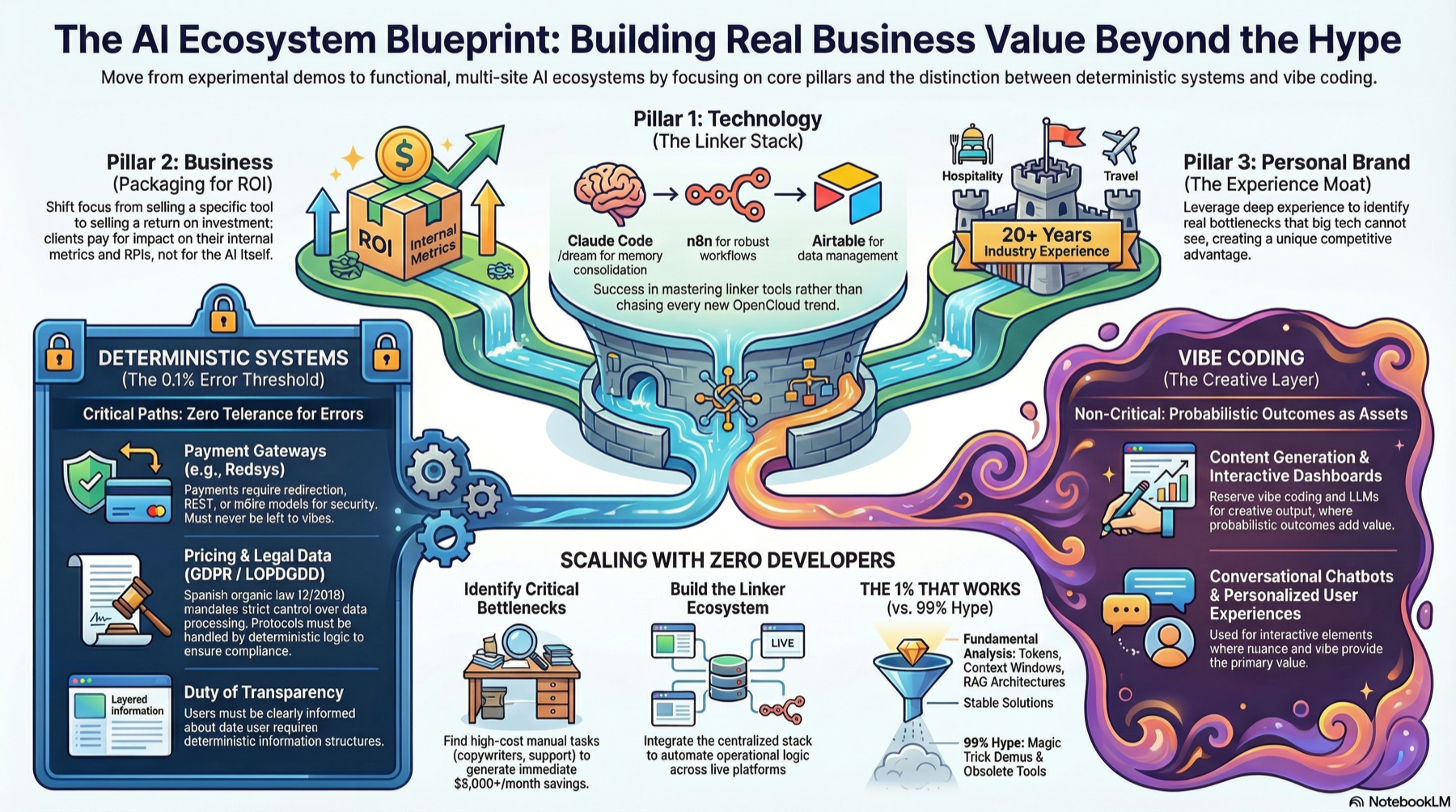
Medina calls it: determinism vs. vibe coding. In n8n, 1+1 is always 2. In vibe coding, 1+1 is “probably 2, but sometimes 1.97.” In my business, “probably” doesn’t exist. A plane ticket costs what it costs.
Tech linkers
The phrase that resonated most: “We’ve become tech linkers.” We no longer invent anything from scratch. Our value is connecting existing pieces to solve problems nobody else is solving in our niche.
That’s exactly what I do:
- Claude Code writes my HTML proposals and chatbots
- Airtable is my CRM with 164+ client files
- n8n syncs supplier prices automatically
- Joomla publishes to viajesscibasku.com
- Vercel deploys my travel wallets in minutes
None of these tools are new or sexy. But together, linked with purpose, they let me do the work of a 5-person team. Alone. From Marbella. With my coffee.
My real ecosystem — what a 73-year-old built
Let me be clear: I’m almost 73. I’m not a digital native. I’m an old guy rewired into a young mind who learned to code with AI at 71. These are the websites I’ve built this past year, all live, all working:
CruceroBuceo.com — A comparator of 92 liveaboards with real prices verified against each supplier’s website. Over 1,000 departures on a live calendar. With an AI chatbot that knows the difference between a north and south Maldives itinerary. All connected: Airtable as database, Cloudinary for images, Vercel for deployment.
ilovecanada.travel — A catalog of 71 Canadian itineraries with a seasonal summer/winter toggle, ski pass calculator, and nearly 22,000 products loaded from Excel spreadsheets. Two color palettes — one for snow, one for nature.
Hummingbird Resorts — A catalog of 208 premium Maldives resorts with over 4,300 photos. Built with Astro 6, connected to the Hummingbird Travel API via OAuth2. Next up: Sri Lanka, Mauritius, Seychelles.
Great Barrier Reef Guide — A complete guide for divers visiting Australia’s GBR. Born as a sales tool for a partnership campaign with Australian operators. Result: commissions of up to 20% with Mike Ball Dive Expeditions.
Personalized Travel Wallets — Premium HTML proposals with integrated AI chatbot that each client receives with their itinerary, real supplier photos, departure countdown, and payment button. Each wallet deploys to Vercel in minutes.
viajesscibasku.com — The mothership. Joomla 5, with 15+ destinations, day-by-day travel programs, and SEO content that ranks.
viajaraegipto.es — Specialized landing for Red Sea diving trips, liveaboard cruises and dive safaris.
lujosinartificios.com — Premium travel without artifice. Authentic luxury experiences, not catalog ones.
aspenski.es — Premium ski portal with international destinations and snow experiences.
Nine websites and counting. Zero hired developers. A 73-year-old, Claude Code, and coffee.
What I do NOT delegate to AI
And here’s the important part, what Medina nails: there are things you CANNOT leave to probability.
- Payments: Redsys, PSD2, strong authentication. Deterministic code, always.
- Personal data: passports, dive certifications, medical data. GDPR, explicit consent, n8n orchestrating — never an LLM deciding what to do with an ID card.
- Final prices: verified against the official source. Period.
AI is my copilot. But I’m the one holding the wheel.
The 1% that actually works
Because this isn’t an anti-AI post. Quite the opposite. That 1% that truly works has changed my life:
- I create premium quotes in 20 minutes that used to take an entire afternoon
- I have a comparator of 92 liveaboards with a smart chatbot that knows every boat
- I publish SEO content for 15+ destinations without hiring a copywriter
- I manage a community of 10,000 divers with content generated weekly
The key isn’t how many tools you know. It’s how many problems you solve.
Stop being a weathervane. Be an anchor.
If you’re in tourism, or any small business, and you feel overwhelmed by AI: stop. Breathe. Ask yourself which process is eating most of your time. And find ONE solution for THAT.
You don’t need 47 tools. You need clarity about your business and three or four pieces well connected.
The rest is hype. And hype doesn’t pay bills.
Giora Gilead Elenberg — Viajes Scibasku, Marbella 20 years organizing dive trips and ski holidays. Rewired since 2024.
What did you think?