10 Claude prompts that changed how I think
You carry the most powerful personal development tool ever built — in your pocket.
You use it to fix emails. To summarise PDFs. To ask what’s for dinner.
It’s like owning a private jet and using it to store luggage.
I’ve been selling travel since the eighties. And using Claude every day for eighteen months. What follows isn’t productivity tips. It’s ten ways of talking to this machine that have changed decisions, habits, and — every now and then — the way I look at myself in the mirror.
Why this post before the video
I haven’t published in over a month. Not for lack of subjects. The opposite — too many.
I’ve spent eighteen months collecting prompts that actually move the needle. Not the ones that save five minutes. The ones that change a day. Or a quarter. Or a year.
I’m putting together a long video with all ten — full prompts, real cases, the data, everything. It’s coming in the next few weeks. But I didn’t want to wait any longer to put something out.
This is the preview. Two prompts told in full. The other eight, just by name. Enough for you to try something today.
A small note before we start
Dr Tasha Eurich has spent years researching self-awareness. Her conclusion: ninety-five percent of people believe they know themselves well. Only ten to fifteen percent actually do.
These prompts exist to close that gap.
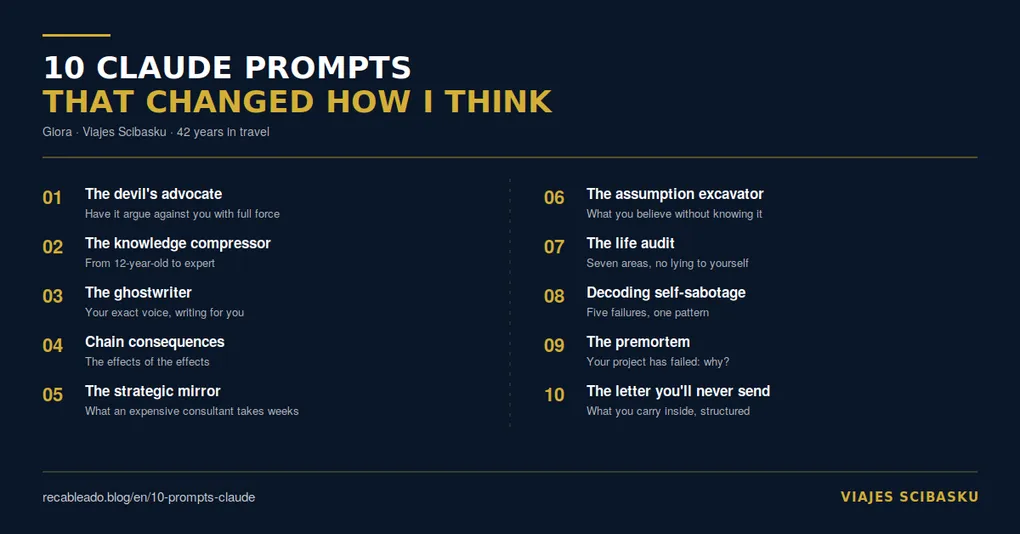
The 10 prompts
- The devil’s advocate. Before you decide, have it argue against you with full force.
- The knowledge compressor. From twelve-year-old to expert, step by step.
- The ghostwriter. Your exact voice, writing for you.
- Chain consequences. The effects of the effects at one, five, and twenty years.
- The strategic mirror. What an expensive consultant takes three weeks to tell you.
- The assumption excavator. What you believe without knowing you believe it, traps you.
- The life audit. Seven areas, one by one, no lying to yourself.
- Decoding self-sabotage. Five failures, one single pattern underneath.
- The premortem. Your project has failed: now, why?
- The letter you’ll never send. What you carry inside, finally given structure.
The first five are useful. The middle ones make you think. The last ones hurt a bit. That’s how it goes. And that’s why they work.
I’ll tell you two in full. The first and the last. The others — in the video.
The devil’s advocate
The prompt:
“I’m about to make the following decision. [Describe your decision]. Argue against it with all the force you can muster. Every flaw, every risk, every assumption I might be wrong about. Don’t hold back.”
Here’s when I used it.
March of this year. I was about to migrate all of Scibasku’s email to a new server. The decision was made. My technical friends were saying “go for it”. My instinct was saying “go for it”.
Before pressing the button, I ran the decision through Claude with this prompt.
It tore me apart.
It warned me I’d lose DKIM. That DNS records take forty-eight hours to propagate. That I had clients waiting for quotes that would bounce straight into spam folders.
Every single thing happened.
But it happened halfway. Because I was already warned.
The difference between a disaster and a controlled crisis is knowing where you’re going to get hit.
Your business partner won’t tell you. Your spouse won’t tell you. Your best friend will tell you too late. Claude tells you before you sign.
Use it before any decision you can’t easily undo. Hiring. Firing. Buying. Selling. Launching. Closing.
An advisor who never disagrees with you isn’t an advisor. It’s a mirror.
The letter you’ll never send
We’ve reached number ten. The most uncomfortable. And the one worth most.
The prompt:
“I need to write a letter I’ll never send. It’s to [person] and [your relationship with them]. Here’s everything I carry inside and never said: [let it all out]. Pour it all out — the anger, the pain, the love, the confusion, whatever’s real. Then I want you to do two things. First, reflect back to me the core emotions and unmet needs underneath all of that. What I was actually asking for and never received. Second, help me write a final version, completely honest — as if I had no fear of consequences.”
There’s someone in your life — past or present — with whom you have unfinished business.
Someone you never told the important thing. A parent who hurt you and will never understand. A friendship that betrayed you and you didn’t confront. A partner who left before you could explain yourself. Someone who died before you could say thank you.
Or a younger version of you. That counts too.
There’s a researcher in Texas called James Pennebaker. He’s spent decades studying what happens to your body when you write down what you carry inside. His data is consistent. People who write about deep wounds — even to people no longer here — show less depression, less anxiety, better immune function. And the effects last for months.
Why does it work?
Because unfinished business consumes energy. Another study — Masicampo and Baumeister — shows that unresolved matters take up active memory in your head. Like browser tabs you’ve forgotten to close. Even when you’re not looking at them, they keep draining resources.
Writing the letter closes the tab.
Not because the person reads it. Because your brain, by structuring what you felt, moves the experience from “processing” to “resolved”.
When you do this prompt — don’t edit. Don’t be fair. Don’t be balanced. Don’t put yourself in their place. That’s not what this is for.
This is for you.
It’s what you’ve carried in your chest for years and never put into words because there was never a safe place to put it.
Now there is.
The two infographics
I’ve put together two versions of the list. One vertical, one horizontal. To save, share, or ignore. As you prefer.
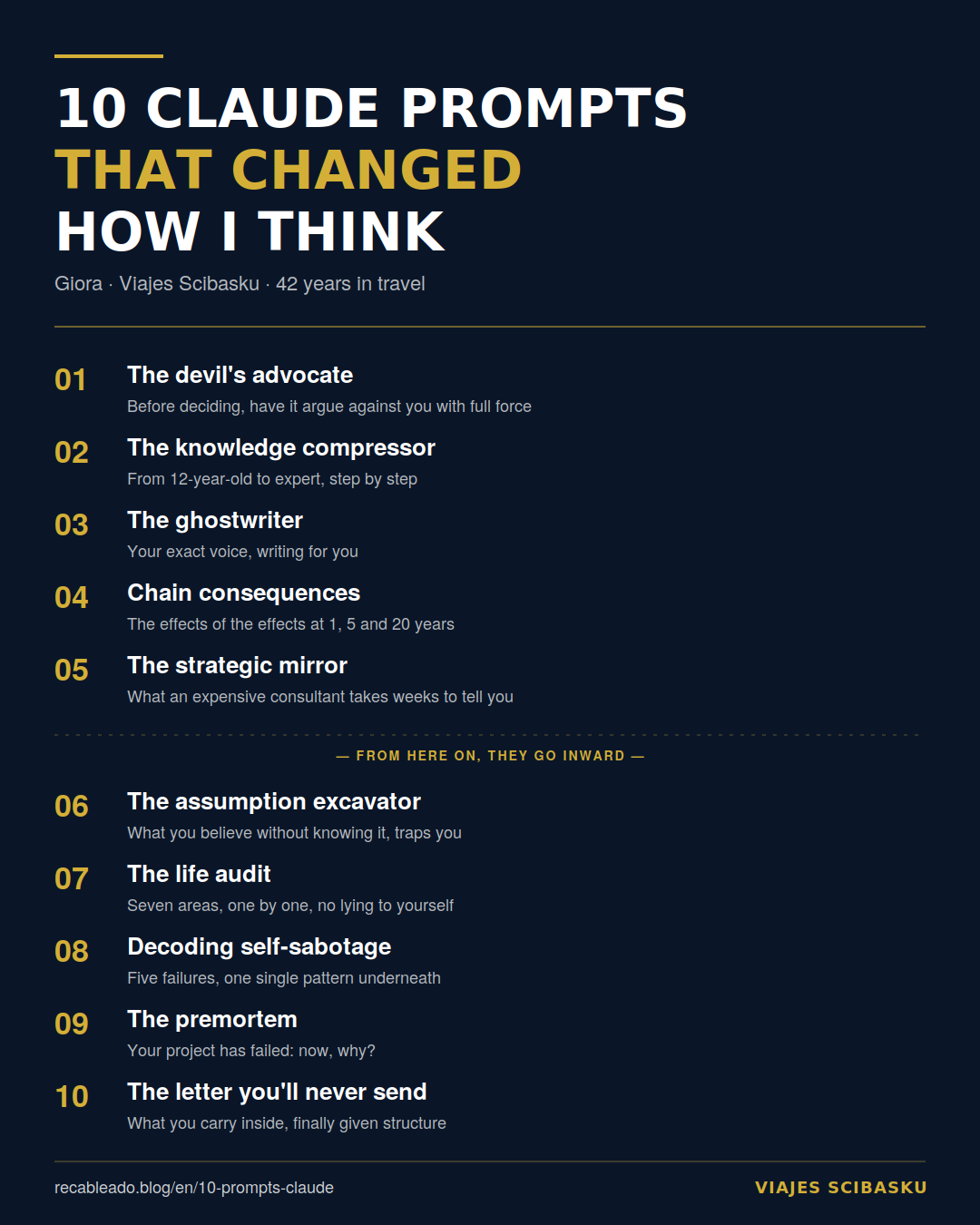
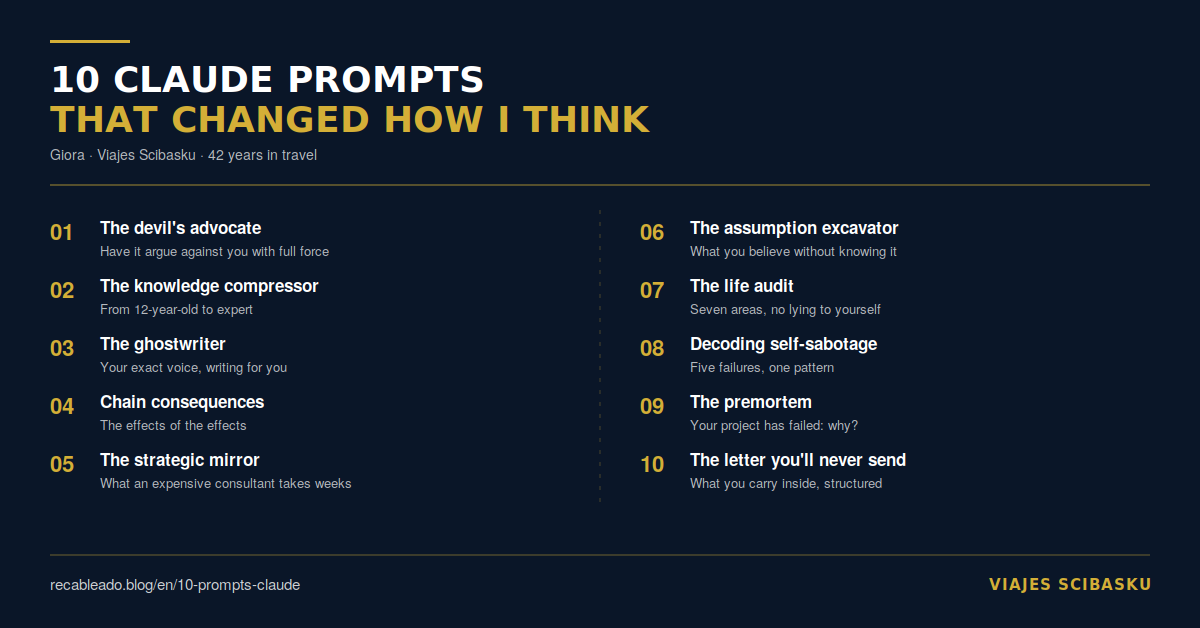
The ten names are there. The literal prompts, the real cases, and the traps I’ve hit using them — those go in the video. Coming in the next few weeks.
Closing
Ten prompts. Each one available right now. No premium subscription. No coding required. No tricks.
The only thing they ask — that you sit down. That you think about what you actually need. And that you ask with precision.
You spend hours every day on your phone. Consuming other people’s thoughts. Other people’s opinions. Edited images of other people’s lives. And by the end of the day you know less about yourself than when you started.
The tool to change that is already in your pocket.
I’ve been selling travel since two thousand and six. And making difficult decisions every day. These prompts spare me grief. Maybe they’ll spare you yours.
Forty-two years of travelling taught me one thing.
I’ve never regretted a trip I took. Only the ones I let pass.
Same goes for this.
A note for international readers: I run Viajes Scibasku, a small travel agency based in Marbella, Spain (CICMA 2283 — the Spanish travel agency licence number). Recableado is my personal blog, where I document this odd journey of an old-school travel agent learning to work with AI.
If you want to know when the video with all ten prompts goes live — real cases, traps, and the data that doesn’t fit in a post — subscribe to Recableado. No daily newsletter. No spam. Just word when there’s something new worth your time.
What did you think?