Five Brains: How I Fixed My Bicycle Tire (and Discovered I'm Not Alone)
“I got a flat tire, can you fix it?” — The story of how I built a system of five minds that does things none of them could do alone.
Intro: The Flat Tire That Changed Everything
I’m on my bike. Marbella road, nothing special. And then: flat tire.
I open WhatsApp. Without thinking. I type: “I got a flat on the Specialized, can you fix it?”
Answer: “No. But we can automate it.”
That was three months ago. Today I have five brains working in parallel. And the craziest part: none of them are me.
Well. One is me. But the other four are a mix of machines, frameworks, and notes that suddenly started talking to each other.
This is what happened.
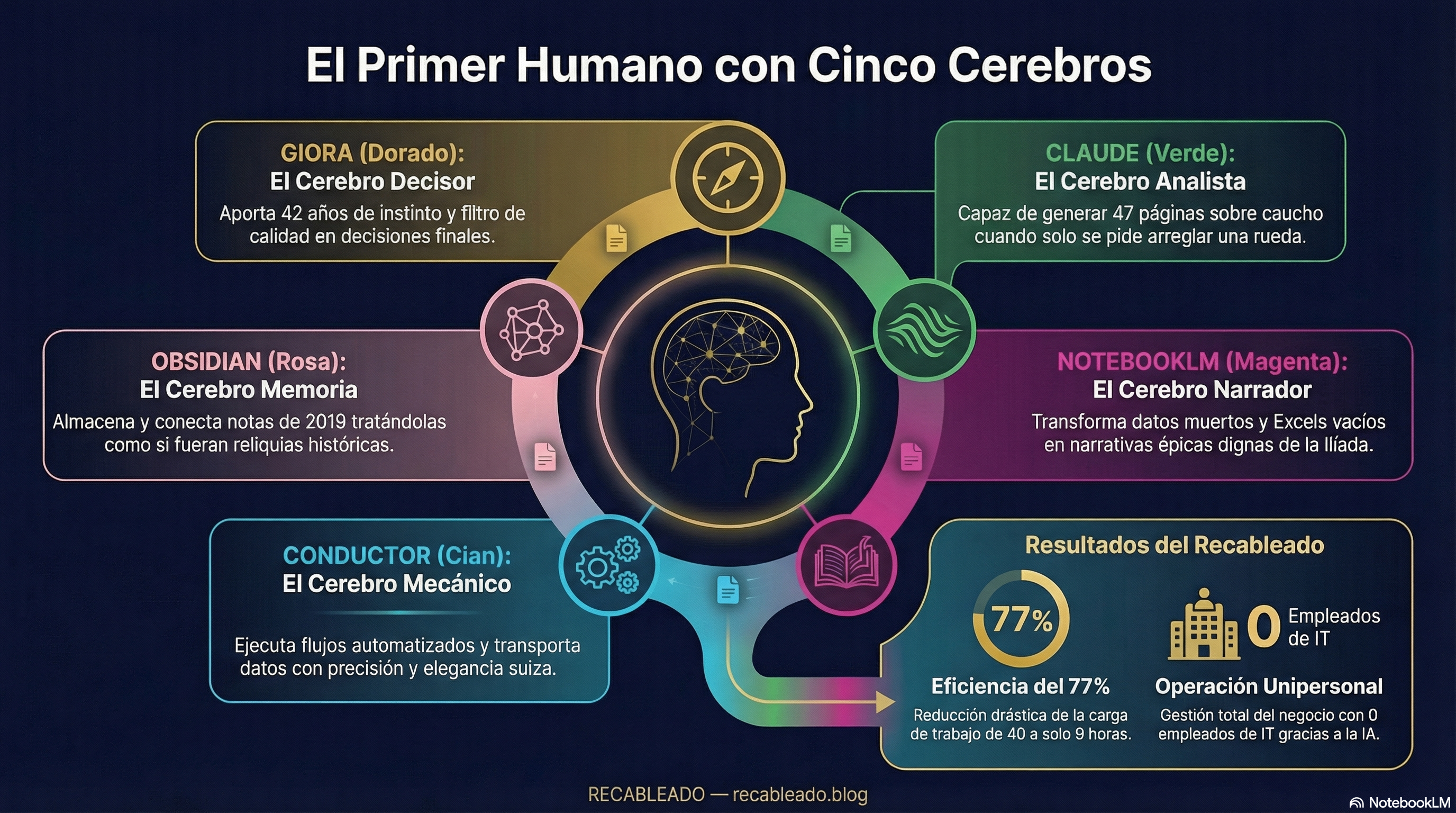
BRAIN 1: GIORA — The Decision Maker
The serious part
I founded Viajes Scibasku in 2006. Four decades before that, I was already on the road. I’ve skied in places where the snow doesn’t fall — it chases you. I’ve dived reefs that don’t show up on Google Maps. I’ve lost luggage in airports across five continents.
That’s my brain. The filter. The one who looks at a photo of an atoll and knows whether the current will cooperate that month. The one who can tell a good boat from a nice PowerPoint.
The ridiculous part
But I have a problem. I’m one person. And one doesn’t scale.
I can’t load 47 liveaboard boats into a database while answering emails, cycling along the promenade, and preparing a quote for Japan. All at once. I used to try. It went… okay-ish.
One day, sitting on the roadside with a flat tire, I thought: “What if I build four more brains to do the heavy lifting while I can’t?”
It wasn’t a plan. It was elegant desperation.
BRAIN 2: CLAUDE — The Know-It-All with Amnesia
The serious part
Claude is pure analytical muscle. Feed it a 200-page PDF of boat specs and it produces a clean comparison table. Ask for a travel proposal and it structures it like an architect. It processes, reasons, connects dots that would take me hours to see.
When you work WITH it, not against it, it’s like having a partner who never sleeps, never complains, and reads faster than any human being.
The ridiculous part
I tell it: “I got a flat on the Specialized, can you fix it?”
It generates a 47-page document. History of the tire. John Dunlop. Optimal air pressure by altitude. Differences between butyl and latex rubber. Comparative patch table.
All correct. All impeccable. All completely useless when you’re sitting on the roadside at 32 degrees.
And the worst part: if you don’t tell it “stop,” it keeps going. Like that friend who, when you ask what time it is, explains how a Swiss watch works. Then the history of Switzerland. Then the Alps.
It’s missing the one thing you can’t program: knowing when to shut up.
BRAIN 3: NOTEBOOKLM — The Epic Narrator
The serious part
NotebookLM is Google, but with a storyteller’s calling. You load documents — PDFs, notes, dense texts — and it transforms them into narratives with an arc. Not summaries. Stories.
It can cross-reference 200 sources and tell you: “Look, this pattern from the Maldives repeats in Indonesia but with different seasonality.” A human would need a weekend to see it. NotebookLM, seconds.
It’s the brain that turns dead data into living meaning.
The ridiculous part
It thinks it’s Hemingway.
You feed it a broken PDF — unstructured text, contradictory data, three-year-old information — and it narrates the catastrophe as if it were the fall of Rome.
“We observe an emergent pattern of profound complexity…” when what you have is a wrecked spreadsheet.
It’s like having a war correspondent who reports the battle with flawless prose. Even though all that happened is two friends argued over who pays for dinner.
Beautiful. Convincing. And sometimes, pure fiction about nothing.
BRAIN 4: CONDUCTOR BUILD — The Swiss Mechanic
The serious part
Conductor Build is the platform that orchestrates AI agents in parallel. The brain that keeps the other three from crashing into each other.
It takes data from here (Drive, APIs, databases). Cleans it. Validates it. Sends it there (Joomla, email, wherever needed). And watches to make sure nothing breaks along the way.
It’s the difference between having five brilliant ideas and having five ideas that actually work in the real world.
The ridiculous part
Conductor is perfect. Precise. Zero creativity, zero surprises. Exactly the opposite of what you need.
If Claude generates confused text, Conductor delivers it anyway. Broken. Carefully. Elegantly. Broken.
If I say “do it” without specifying what, it waits. Six hours. Politely.
It’s a Swiss watch with the hands put on backwards: it runs with absolute precision. It just tells the wrong time.
BRAIN 5: OBSIDIAN — The Infinite (and Grudging) Memory
The serious part
Obsidian isn’t a tool. It’s a nervous system.
Every destination, every client, every boat, every experiment lives there. And the crucial part: the notes connect to each other. Maldives links to “clients who dive.” Which links to “February is a good month.” Which links to “Sebastián is the captain who knows those reefs.”
The other brains consult it. Claude looks up data. NotebookLM synthesizes patterns. Conductor turns notes into actions.
It’s the bridge between what I know and what I do.
The ridiculous part
Obsidian has a narcissistic problem: it thinks it’s immortal.
It keeps a note from 2019 that says “Research Indonesia liveaboards” as if it were a Dead Sea scroll. No context. Unresolved. Still there. Waiting.
It doesn’t delete. It doesn’t decide. It doesn’t prioritize. It simply accumulates.
It’s like having a perfect archive where everything can be found… but nobody decided what deserves to be there.
Without the other four brains to review, filter, and act, Obsidian is a beautiful library. With a dead librarian.
How They Work Together (When They’re Not Fighting)
The ideal flow
- Giora decides. “Let’s build a liveaboard boat database.”
- Claude structures. “We need 23 fields, organized like this.”
- Conductor executes. “Data validated, ready.”
- Obsidian stores. “Pattern detected: boat + destination + month = optimal experience.”
- NotebookLM tells the story. “Here’s what we discovered…”
- Giora reviews. “Yes, but the story of why February is different is missing.”
- Back to step 2.
Circle. Not line.
The actual chaos
Sometimes everything breaks at once.
Conductor throws an error. Obsidian has data from 2019. NotebookLM writes poetry about an empty spreadsheet. Claude hallucinates a number with total confidence.
When that happens, I see it. And instead of throwing everything away, I ask: “Which of the five got it wrong?”
And I fix it.
It’s not a fragile system. It’s a system where errors are visible. Which is exactly the opposite of working alone, where you discover mistakes three months later.
The Experiment: 90 Days with Five Brains
Month 1: Five strangers in an elevator
Claude produced correct texts with no soul. Conductor tried to push data into Joomla and broke every hour. Obsidian accumulated notes like it was collecting stamps. NotebookLM epically narrated incomplete documents.
And I was screaming (internally) what anyone would scream: “Why does nothing make sense?”
Month 2: They start talking
It wasn’t magic. It was slow. And boring.
Claude needed clear instructions to stay on track. Conductor needed clean data to stop delivering pretty garbage. Obsidian needed structure from day one. NotebookLM needed validated documents to tell real stories, not novels.
And I learned something uncomfortable: don’t trust anyone’s first draft. Including my own.
The key was creating useful friction. Each brain became quality control for the one before it.
Month 3: It works (more or less)
Today I write “I need content for 5 new destinations” and I have a draft in 2 hours. I review it in 30 minutes. Fix tone, stories, reality. Claude adjusts in 15. Conductor publishes in 5.
Did I really go from 40 hours to 3? Well, 3 plus the 6 I spend fixing what the five brains broke together. But the trend is going in the right direction.
The Three Lessons
1. A single brain always gets it wrong
Me alone = 42 years of bias. Claude alone = 47 pages about rubber. NotebookLM alone = prose about garbage. Conductor alone = precision executing the wrong idea. Obsidian alone = information graveyard.
Five together = a system where errors show up before they hurt.
2. Machines don’t decide. They make decisions visible.
What took me 40 hours is now seen by five perspectives in less time. It’s not that it’s faster. It’s that every error surfaces instantly.
3. This isn’t for anyone who wants ready-made software tomorrow
It makes sense when you have experience no machine can replicate, you need scale but don’t want to lose your voice, and you’re willing to spend months fine-tuning.
It’s not technology. It’s a different way of thinking about what you should be doing versus what others can do. Even if “others” are four machines with personalities of their own.
And the bicycle tire?
Oh right. The flat.
I never fixed it.
I started thinking about how to prevent the next flat. Pressure data. Road history. Preventive alerts.
That’s not fixing a tire. That’s thinking differently about the problem.
And that’s exactly what happened over these three months. I didn’t build tools to do what I used to do. I built a system to stop doing what I shouldn’t have been doing in the first place.
Recableado. Where what breaks gets rebuilt differently.
PS: This post was written by all five brains. Claude drafted it. NotebookLM suggested the narrative structure. Conductor published it. Obsidian stored the 14 previous versions (all worse). And I decided which one was good. As always.
PS2: If my wife reads this, she should know the sixth brain is her. And that one can’t be automated.
What did you think?