I organized a ski trip to Japan for 12 people at 72. AI was my co-pilot
Ten days, twelve people, Japan. A shoulder dislocation at 1,200 meters of altitude, lost ski passes, and a Hong Kong extension in the middle of Chinese New Year. I managed all of that in February 2026 from my phone, with Claude and WhatsApp, at 72 years old. Here’s what I learned.
What does AI have to do with a ski trip?
I’ve been organizing group trips since 1982, when I set up my first travel agency. Forty years of paper files, landline phones, and fax machines. The fax. Yes.
Today I’m 72 and I’m still organizing trips. But something has changed radically in the last two years: I have an assistant that works with me at three in the morning, never complains, never makes calculation errors, and can draft a letter to the insurance company in English, Spanish, and Japanese in thirty seconds.
It’s called artificial intelligence. And this February I used it to organize the most complex trip I’ve put together in years: ten days for twelve people in Niseko (Japan) plus an extension to Hong Kong coinciding with Chinese New Year. With a shoulder dislocation in the middle.
This isn’t an article about travel. It’s an article about what AI can do when you put it to work on something real.
How did I use AI to plan the Japan + Hong Kong itinerary?
The basic idea was clear: group of twelve friends and family, Niseko for skiing, dates in February. What wasn’t clear was how to make the most of the flight days without wasting hours.
This is where Claude came in for the first time.
I asked: “I have a group flying from Madrid to Niseko with a stopover. We’re in February, which coincides with Chinese New Year. Does it make sense to add a three-day extension in Hong Kong? What’s the exact date of Chinese New Year in 2026?”
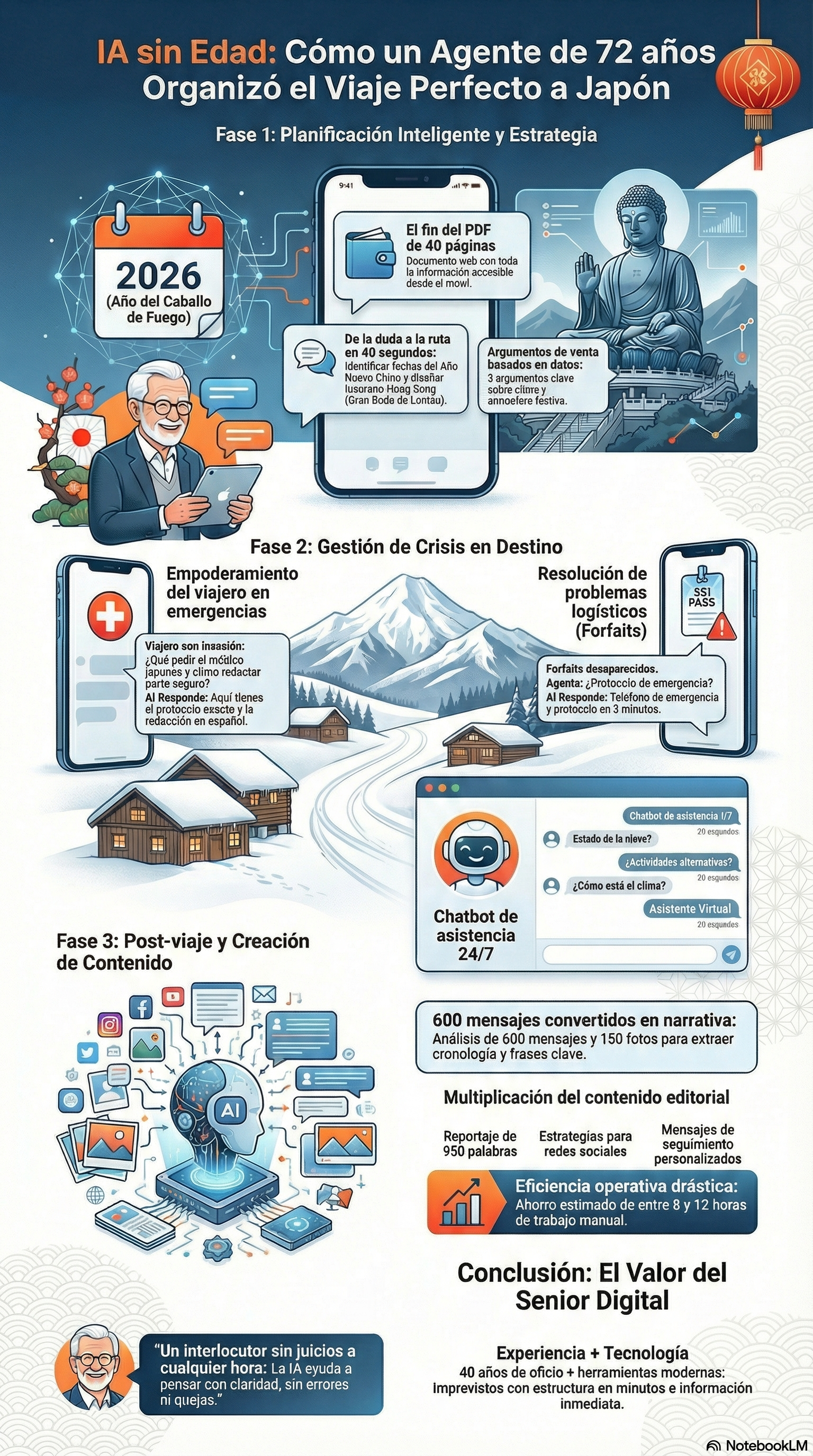
In forty seconds I had: the exact date (January 29, 2026, Year of the Fire Horse), what atmosphere to expect in Hong Kong at that time, a warning about hotels (book far in advance), and three arguments to sell the extension to the group.
What would have taken me an hour of Google searches through travel blogs and outdated forums, I resolved in one conversation.
The extension was added. The group rated it as one of the best moments of the trip.
How did I design the Hong Kong itinerary?
I sent Claude the number of available days, the group profiles (mix of ages, one member with reduced mobility, interest in culture and gastronomy) and asked for an itinerary with my priorities.
It returned a structured proposal that I adjusted with my own judgment. The group followed it almost to the letter.
| Day | Activity | Why |
|---|---|---|
| Day 1 | Big Buddha Lantau + cable car | Iconic, maximum visual impact |
| Day 2 | Wong Tai Sin Temple + night markets | Chinese New Year at its peak |
| Day 3 | Victoria Peak + dinner at Peking Garden | Visual close to the trip |
The dislocated shoulder: can AI help the traveler directly in an emergency?
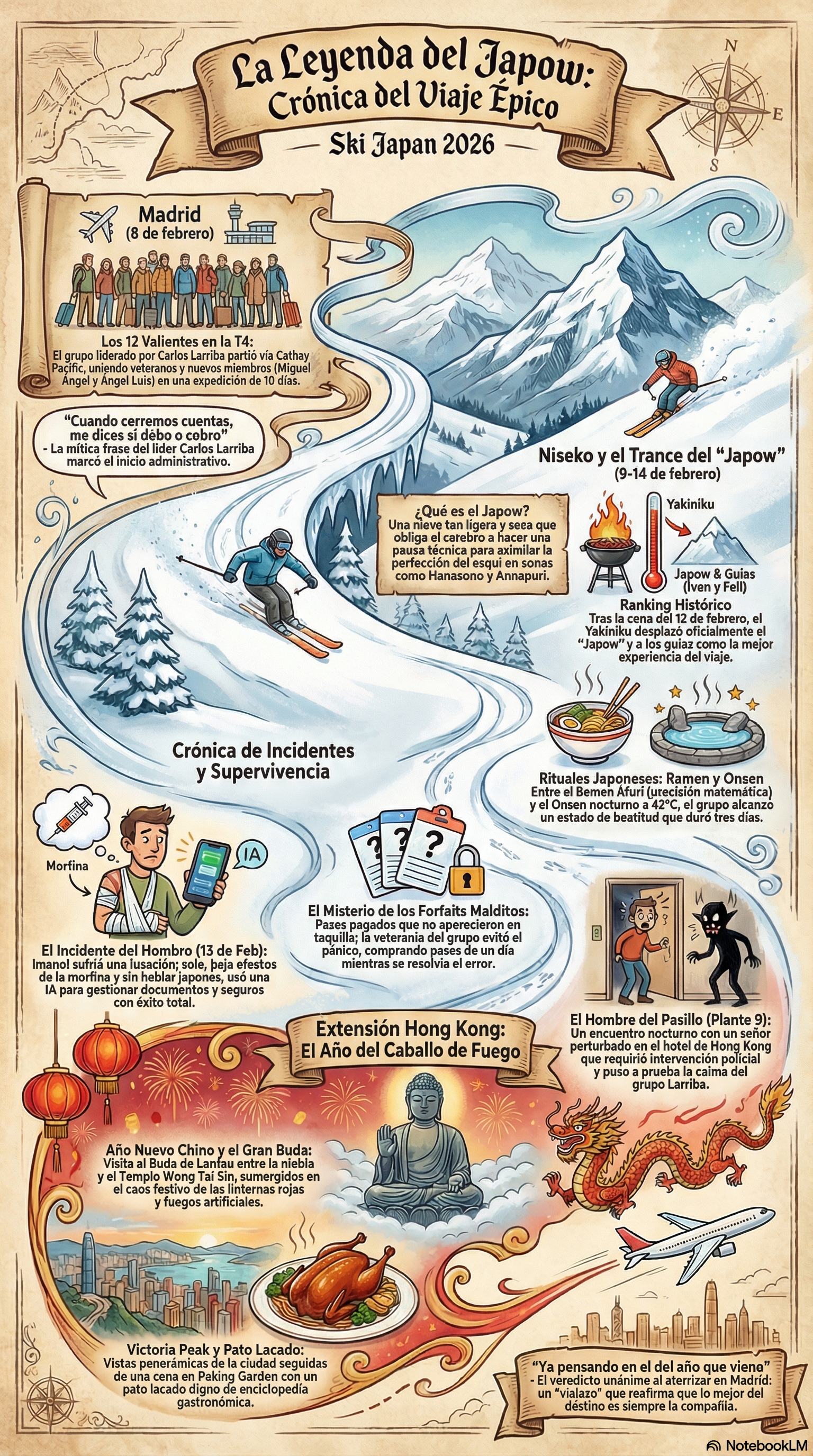
Day 5 in Niseko, one of the group members fell on the slope. Dislocated shoulder. Morphine. Transfer to the traumatologist.
What happened next I only found out days later: he managed it himself. From the waiting room of a Japanese hospital, shoulder immobilized, no Japanese, no one from the group with him at that moment, he turned to AI.
He asked what medical documents to request for the insurance claim, what ski accident coverage typically looks like, and how to communicate with his insurer from Japan.
In a few minutes he had:
- The list of medical documents he would need for the claim
- The standard coverage clauses for skiing accidents
- A draft message to send to his insurer in Spanish
He sorted it himself. The rest of the group kept skiing. The incident was properly documented and the insurance claim went through without issues.
What this shows: AI isn’t just a planning tool. It’s a resource available at the most unexpected moment, for the traveler directly — not just for whoever organized the trip. In a country with a language barrier and at odd hours, that makes a real difference.
The lost passes: one night finding solutions from home
Same trip, another front. Some ski passes that had been issued weren’t showing up at the resort ticket windows. The group was on the slopes. The provider’s offices had closed.
I asked an AI for the provider’s emergency phone number and the standard resolution protocol for these cases. In less than three minutes I had the number, the urgent support channel, and the industry’s standard solution.
I called. I got through on the third attempt. The solution: the group would buy a one-day pass directly at the window, and I would reimburse them. The correct passes would come through for the next day.
What would have been a night of desperate searches through PDF contracts and archived emails became a twenty-minute management task.
¿Te está gustando? Compártelo
The travel wallet: the document that replaced 40 pages of paper
One of the most practical changes I’ve introduced in my expeditions thanks to AI is what I call a travel wallet: an interactive web document with all the trip information accessible from a phone.
For this group it included flights, hotel, ski passes, itinerary, and emergency numbers. Plus an AI chatbot trained on the trip data that answered travelers’ questions at any time.
One group member asked me at eleven at night whether they could do something the next day if the snow was bad. Instead of searching through the PDF, I said: “Ask the travel wallet chatbot.” They had their answer in twenty seconds.
I built the document with Claude’s help in one afternoon. What used to be a forty-page PDF that nobody read is now a web page that travelers actually use.
After the trip: 600 messages and 150 photos turned into content in one afternoon
When the group returned, the WhatsApp chat “Ski Japan 2026” had more than 600 messages and 150 multimedia files.
Before AI, that material slept on everyone’s phones until memory erased it.
This time, I asked Claude to read the entire group conversation. In a few hours I had:
- A complete chronology of the trip with the most significant moments
- The verbatim phrases that had the most impact on the group
- A 950-word editorial report ready to publish on ski portals
- Three personalized follow-up messages for each profile in the group
- A social media content strategy with captions and Reel ideas
- The expedition closure checklist
- This article you’re reading now
All content based on real data, real phrases, real moments. Not generated from nothing, but distilled from what the group lived and shared.
That’s what AI changes for someone who works with people and experiences. It doesn’t invent. It organizes, amplifies, and gives shape to what already exists.
Is it worth it? What a senior can do with AI that was impossible before
I’m 72 years old. I’ve organized trips my entire professional life. And I can tell you with certainty what has changed since I started using AI in my work:
Before: Information took time. Unexpected events at odd hours were exhausting. Closing paperwork took days. Post-trip content (photos, reviews, commercial follow-up) was rarely done well.
Now: Information is immediate. Unexpected events have structure in minutes. Closing an expedition is one afternoon. Content gets generated and used.
What has surprised me most isn’t the speed. It’s the ability to have an interlocutor at any hour, without judgment, that helps me think clearly when the situation is complex.
At two in the morning, with an injured traveler in Japan, that’s worth a lot.
¿Te está gustando? Compártelo
Frequently asked questions
Do I need to know how to code to use AI for travel?
No. Everything I describe in this article I did in natural language, writing or speaking the way I would with any person. No code, no technical jargon.
What AI did I specifically use?
Mainly Claude (by Anthropic) for drafting, analyzing, and managing information. WhatsApp as the group’s communication channel. The travel wallet chatbot also uses Claude as its engine.
Is it safe to share trip data with an AI?
I used non-sensitive information: itineraries, schedules, destination data. The travelers’ personal data (passports, cards) I don’t share with any AI. The same criteria you’d apply with any digital tool.
How much time did AI save me on this trip?
Honest estimate: between 8 and 12 hours of work spread across planning, on-destination management, and post-trip closure. For a twelve-person expedition, that’s significant.
Can the same be done for family trips, not just agency groups?
Absolutely. The travel wallet, the chatbot, the AI-planned itinerary… all of it applies equally to a family trip of four people. It scales down without a problem.
Have you used AI to organize a trip? Tell me in the comments. The best cases I’ll share in the next article.
What did you think?