The night my AI and I looted a library of 75 books... and walked out with just one
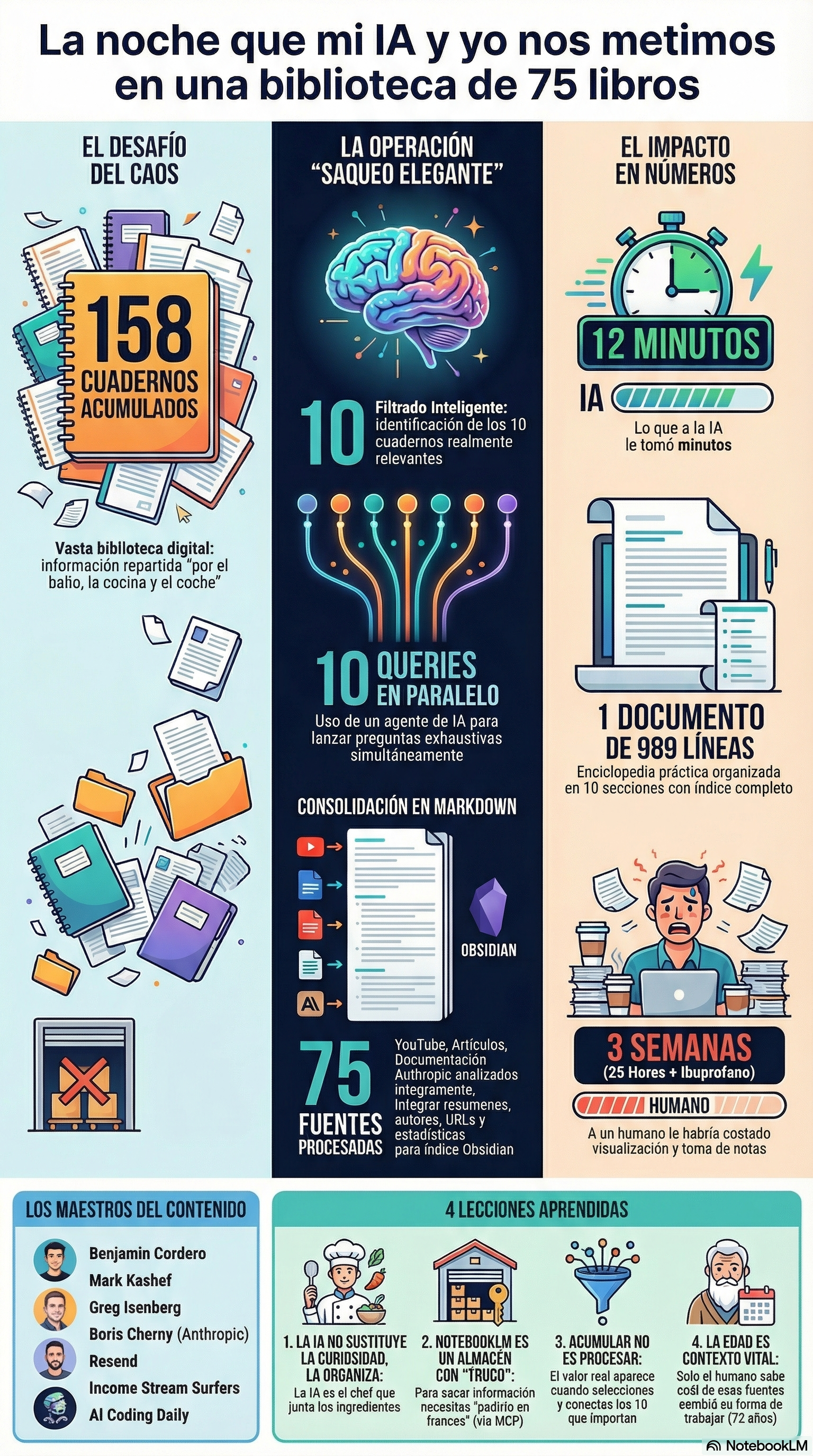
I asked Claude to read 75 sources spread across 10 NotebookLM notebooks and consolidate everything into a single document. It did it in 12 minutes. It would have taken me three weeks. I’m 72 years old, I’ve been using AI intensively for 2 years, and this was the moment I truly understood what an agent is for.
Why is having 75 sources in 10 notebooks worse than having none?
I’ve been consuming YouTube videos about Claude Skills the way you eat sunflower seeds: compulsively, with no order, and with the table covered in shells. A Benjamin Cordero video here, a Mark Kashef one there, an Anthropic guide in between, and that Greg Isenberg guy explaining how to set up a digital employee that works while you sleep (which, at 72 years old, interests me considerably more than it would a 25-year-old).
The result: 10 notebooks in NotebookLM. 75 sources including videos, articles, and official documentation. All stuffed into different drawers. Like having an entire library but with the books scattered across the bathroom, kitchen, car, and the neighbor’s house.
And every time I needed to remember something — “how did that Trigger Words thing in Skills work?” or “what design pattern did Anthropic recommend?” — I had to open three notebooks, watch two videos at 2x speed, and pray that my memory (mine, not the computer’s) would cooperate.
Can an AI read 10 NotebookLM notebooks at once?
Yes. Using NotebookLM’s MCP (Model Context Protocol), an AI agent can query all your notebooks from outside the platform, in parallel. It doesn’t give you raw text, but if you ask the right way, it tells you everything in detail.
One Sunday morning, coffee in hand, I thought: “What if I ask Claude to go into NotebookLM, read EVERYTHING, and put it all in one place?”
Sounds simple. It’s not.
NotebookLM is like a luxury hotel: it lets you in, gives you a beautiful room, but won’t let you take the towels. YouTube video transcriptions are inside the platform, processed, but there’s no “download transcription” button. It’s like having an incredible chef at home who cooks wonderfully but refuses to give you the recipe.
But it turns out there’s a back door. Well, more like a service window: the NotebookLM MCP. A protocol that lets you query your notebooks from outside.
¿Te está gustando? Compártelo
How do you ask an AI to consolidate 10 notebooks?
I explained the plan to Claude (my AI agent, not a friend with a weird name):
Giora: “I need you to read 10 NotebookLM notebooks and consolidate everything into one document. But the transcriptions can’t be downloaded.”
Claude: “I can use the MCP to run exhaustive queries. Want me to list all your notebooks first?”
Giora: “All of them? How many do I have?”
Claude: “158.”
One hundred and fifty-eight. I didn’t even know some of them existed.
The plan was:
- List all 158 notebooks and select the 10 relevant ones about Skills
- Launch exhaustive queries to all 10 notebooks simultaneously. In parallel. Ten questions at once. Like an intellectual octopus.
- Get the URLs for each source video for references
- Consolidate everything into a single Markdown document
And Claude did it. Without complaining. Without asking for a coffee break. Without saying “this isn’t my thing” or “I need more context.”
It just… did it.
How long did the AI take to process 75 sources?
12 minutes. In that time, Claude:
- Listed 158 notebooks and selected the right 10
- Launched 10 queries in parallel (one per notebook) with prompts like: “Summarize ALL content exhaustively. Include all concepts, practical examples, steps, code, recommendations…”
- Retrieved details for all 75 sources (titles, authors, YouTube URLs)
- Consolidated everything into a 989-line document with an index, 10 complete sections, and a statistics appendix
- Saved it in three different places (Obsidian, Desktop, and offered to upload it to Drive)
For perspective:
| AI (Claude + MCP) | Human (me) | |
|---|---|---|
| Time | 12 minutes | ~3 weeks (25h of videos + notes) |
| Sources processed | 75 simultaneously | 1 at a time, with distractions |
| Result | 989 organized lines with index | Loose notes in 10 notebooks |
| Cost | ~$0.50 in API | 2 boxes of ibuprofen |
And that’s assuming I don’t get distracted by a ski video from Niseko popping up in YouTube recommendations (which happens 100% of the time).
What’s inside a 989-line document about AI Skills?
The result is a kind of “practical Skills encyclopedia” with everything I’ve learned over months, but organized:
Skills vs MCP vs Prompts (Benjamin Cordero) → Skills are SOPs, not prompts. MCP is the USB-C, the Skill is the “how”
The 5 design patterns (Mark Kashef / Anthropic) → Sequential, Multi-MCP, Iterative, Branching, Domain
Front-end Design (Income Stream Surfers) → Skills that eliminate “AI slop” from web design
Clawdbot/Moltbot (Greg Isenberg) → A 24/7 digital employee that works while you sleep
Best practices (Boris Cherny, Claude Code creator) → The perfect workflow: Plan Mode, Hooks, Sub-agents
What did I learn that AI can’t teach you?
1. AI doesn’t replace curiosity, it organizes it
I had already watched all those videos. But having them scattered across 10 notebooks is like having paella ingredients spread across three supermarkets. Claude was the one who gathered them in the kitchen and said: “Here you go, now cook.”
2. NotebookLM is an incredible warehouse with a terrible loading dock
Fantastic for storing information. Terrible for getting it out. Until you discover you can ask it broad questions via MCP and have it “tell” you everything.
3. Having 158 notebooks doesn’t make you smarter
I found out I had notebooks about Shakespeare, Damascus Rose, and an empty untitled one. Accumulating information isn’t the same as processing it. Sometimes you need someone (or something) to tell you: “Hey, out of these 158, the ones that matter are these 10.”
4. Age is an advantage, not an obstacle
At 72, I have something no AI model has: life context. I know what information is useful because I’ve been traveling for 42 years and using AI intensively for 2 years.
Claude processed 75 sources in 12 minutes. It took me 42 years to know what questions to ask.
The speed is its. The direction is mine.
Was it worth it? The final result
A 989-line document that now lives in my Obsidian, ready to consult whenever I need to remember how a Skill is structured, what design patterns exist, or how to configure a Hook so Claude doesn’t delete files without permission.
It’s not perfect. The transcriptions extracted via query aren’t identical to the originals (they’re exhaustive summaries, not literal text). But it’s infinitely better than having 75 videos scattered across 10 notebooks with no connecting thread.
Now comes what always comes after organizing: using what you organized. I have 14 Skills configured in my travel agency, each born from one of these videos. And with this consolidated document, I can improve them, create new ones, and — above all — stop watching the same Mark Kashef video for the third time because I can’t remember where he explains the Trigger Words thing.
(It’s in section 2.5, in case you’re wondering. I don’t have to search anymore.)
Watch how it happened
How much information do you have scattered around that could be working for you?
I had 158 notebooks. I use 10. The rest is noise converted into data.
How many do you have that you don’t even know exist?
Frequently asked questions
What is the NotebookLM MCP? It’s a protocol (Model Context Protocol) that allows AI agents like Claude to query your NotebookLM notebooks from outside the platform. It doesn’t download transcriptions, but obtains exhaustive summaries of all content.
Do I need to know how to code to use this? No. I don’t know how to code. You just need Claude Code installed and the MCP configured. You give instructions in natural language and it executes the technical queries.
Is it free? NotebookLM is free. Claude Code requires a subscription ($20/month). MCP queries consume API tokens, but 75 sources cost approximately $0.50.
Does it work with any content in NotebookLM? Yes. YouTube videos, PDFs, web articles, pasted text. Everything you’ve added as a source to a notebook is queryable via MCP.
Is the resulting document an exact copy of the sources? No. They are exhaustive AI-generated summaries from queries. They capture concepts, examples, and recommendations, but are not literal transcriptions.
Resources mentioned:
- NotebookLM MCP on GitHub — the connector that made the heist possible
Giora Gilead · 72 years old · Marbella, Spain
Travel entrepreneur since 1982 (CICMA 2283). I’ve been using AI intensively for 2 years to run a boutique travel agency. 14 Skills configured, 3 chatbots deployed, and a blog where I share what I learn without filters.
Exploring the last continent: AI. From Marbella, with coffee and an agent that never sleeps.
What did you think?